Vineland Elite Roofing brings more than 20 years of roofing in Woolwich and across South Jersey to a job that is becoming common in the township: replacing a house’s first roof. For a lot of owners here, the shingles overhead are the ones that came with the house, and nobody in the family has been through a re-roof on it before. That makes the first estimate the right moment to ask careful questions.
We start with what the roof is actually doing rather than its age alone. A leak call gets a look in the attic as well as on the shingles, so we can trace water to the place it really enters before anything is priced. If the roof has years left and only needs a repair, we say so plainly before replacement comes up at all.
When replacement is the right call, the first one is a chance most roofs only get once. The original layer comes off, the deck is exposed, and the shingle, underlayment, ventilation and edge metal are all chosen by you instead of inherited. The sections below walk through how that works on the houses this township added so quickly.
Woolwich’s 2000s Boom and Roofs Entering Their Twenties
A township built in two decades
Woolwich Township grew faster than almost anywhere else in New Jersey. Census counts put it at 3,032 people in 2000 and 10,200 in 2010, and New Jersey Future ranked it the fastest-growing municipality in the state that decade apart from tiny Teterboro. The 2020 census counted 12,577, the highest total in the township’s history.
The housing tells the same story. Of the 4,401 housing units in the latest five-year American Community Survey, 2,151 were built from 2000 to 2009 and another 1,093 from 2010 to 2019. That puts 73.7% of the township’s homes inside a twenty-year window, so a large share of its roofs are close to one another in age.
Weatherby and the newer subdivisions
Much of that growth landed in the Weatherby development. A township official told Business View in 2022 that a lot of homes had been built there over the previous 20 years, and that it would be about 4,200 homes once built out. Listings name the Villages at Weatherby association, and a 2014 home in the Courts at Woolwich shows the newer streets kept filling in after the first wave.
Because these houses went up in batches, neighbors often reach roofing decisions within a few years of one another. That can help, since you can see how a similar roof nearby has weathered and what its owner chose when it came off. It is also why we inspect each house on its own instead of assuming one answer fits a whole street.
What 17 to 26 years means for a roof
A roof put on a house built between 2000 and 2009 is now 17 to 26 years old. The InterNACHI life-expectancy chart that home inspectors use lists 20 years for a 3-tab asphalt shingle and 30 for an architectural one. Which shingle line went onto any Woolwich house is not recorded, so we do not guess from the street; we look at the roof itself.
That chart is a guideline, not a verdict. InterNACHI notes that a roof’s life depends on local weather conditions, building and design, material quality and adequate maintenance. A roof from the 2000s may have plenty left or may be showing its years, and the only way to tell which is to get up on it and into the attic.
A straight answer before any talk of replacement
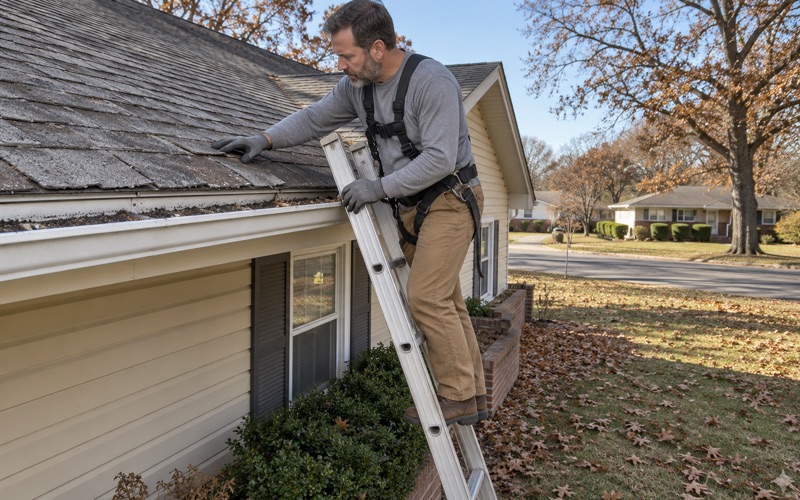
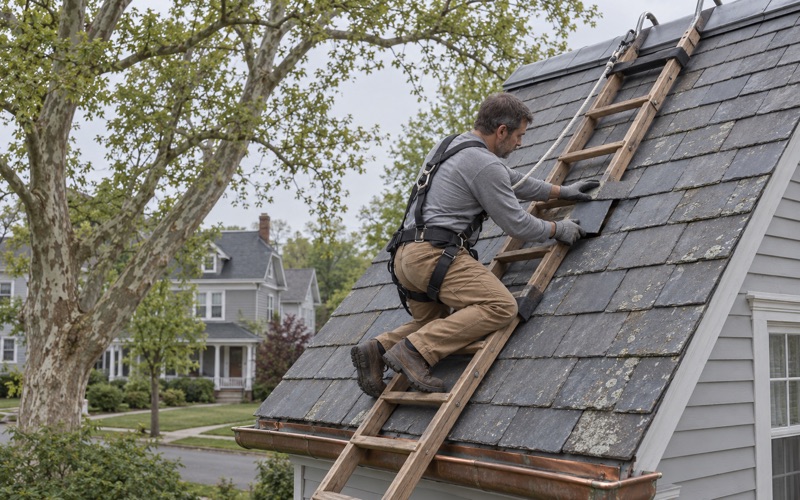
Our first visit ends with a clear recommendation: repair, keep an eye on it, or replace. Lifted tabs on one slope, a cracked pipe boot or a single flashing leak can usually be fixed without disturbing the rest. When brittle shingles, heavy granule loss and soft spots show up across the whole roof, we explain why a patch would only buy a season.
Looking for roofing closer to Woodbury? See Roofing in Woodbury.
The First Tear-Off: One Layer and a Clean Deck
Why a first replacement is the simpler one
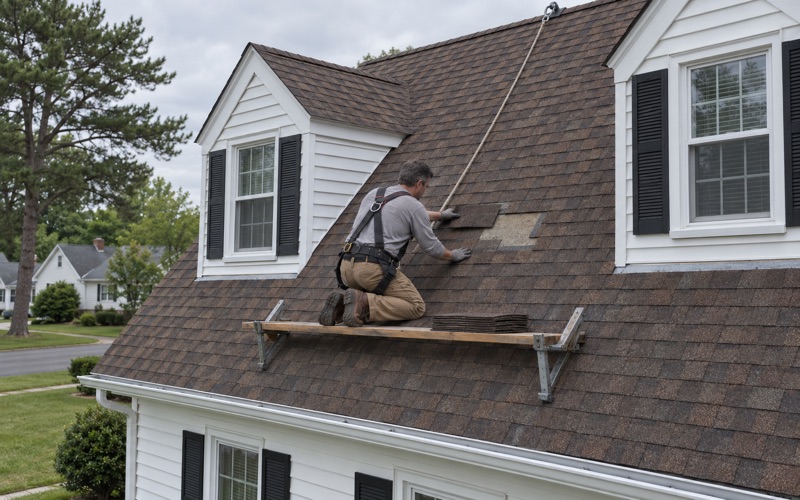
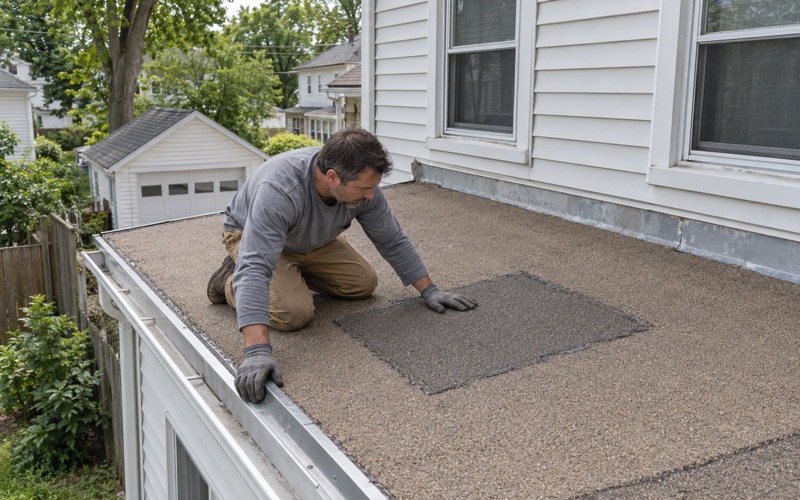
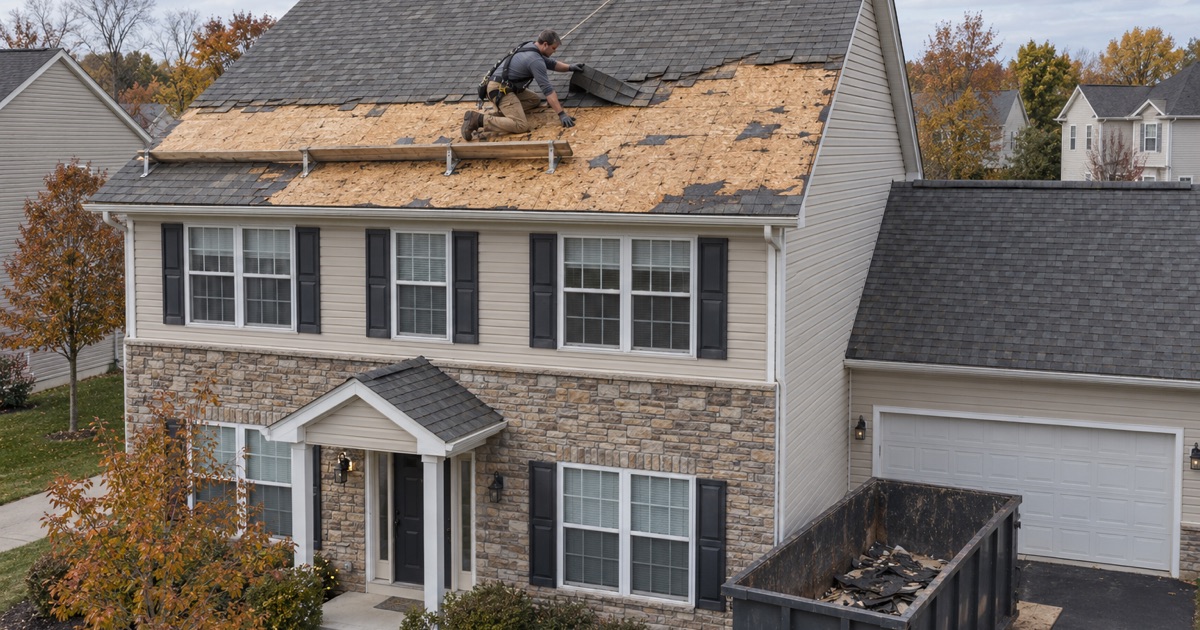
An original roof on a house from the 2000s or 2010s is normally a single layer, which keeps the tear-off straightforward. The old shingles and underlayment come off down to the decking, and nothing new is laid over a worn layer. Starting from bare wood is what lets every later choice, from underlayment to edge metal, go on the way it should.
Stripping to the deck also shows what two decades did underneath. Nail pops, gaps at sheathing joints and stains around vents and pipes all become visible once the shingles are gone. We would much rather find those with the roof open and dry than learn about them later through a stained ceiling in a bedroom.
Decking found once the shingles are off
If any sheathing is soft, delaminated or stained through, we photograph it and show you before it is replaced. The price per sheet is set in the contract ahead of time, so a damaged board becomes a known line item rather than a surprise on the final bill. On a newer house the deck is often in decent shape, and the photos make that just as clear.
You see the same pictures we see, taken on your roof that day. That record also helps if you sell, because the next owner can see what was under the old shingles and what was done about it. Nothing about the deck is decided out of your sight or added to the bill without a photo behind it.
A tidy street at the end of each day
In a subdivision, driveways, sidewalks and the neighbors’ cars sit a few yards from the work. We clean the yard, driveway and gutters at the end of every working day, including a magnet sweep for roofing nails. Nobody on the street should learn you had a roof done by pulling a nail out of a tire.
Tear-off debris goes straight into a container rather than piling up on the lawn. Planting beds along the foundation are covered where shingles will come down, and the gutters are cleared of grit and nails instead of being left for the next heavy rain to flush out onto the driveway.
Choosing the Shingle the Builder Chose for You
3-tab or architectural
The first replacement is the first time the shingle is truly your decision. Whatever went on originally was selected when the house was built, before you had any say. Owners at this stage often look at architectural, or laminated, shingles, the longer-lived of the two types on the inspector chart, which also give the roof line more depth and shadow.
Widely installed architectural lines include GAF Timberline HDZ, Owens Corning Duration and CertainTeed Landmark. We bring samples of the options that suit the house and the budget, and we talk through how they differ in profile, weight and the matching ridge caps and starter strips each manufacturer pairs with its shingle.
Ratings worth reading on the bundle
Shingle packaging carries test ratings that tell you more than a brochure does. ASTM D3161 Class F and ASTM D7158 Class H refer to wind resistance testing, UL 2218 Class 4 to impact resistance, and ASTM E108 or UL 790 Class A to fire rating. Not every line carries all of them, so we show you which apply to the shingle you are weighing.
Woolwich falls in National Weather Service forecast zone NJZ017, Gloucester, issued from the Mount Holly office. When a storm warning for that zone does turn into damage on your roof, we photograph it and write it up for your own claim, and our crew will meet the insurance adjuster on site whenever you ask us to.
Color held up against your house
A new roof changes how the whole front of a house reads from the street. We hold shingle samples up against your actual brick, stone or siding, in daylight, so the color is judged on the house rather than on a small printed swatch. A shade that looked right on a display board can look quite different beside vinyl siding and white trim.
Ventilation, Underlayment and Edges on a First Replacement
Underlayment and ice barrier
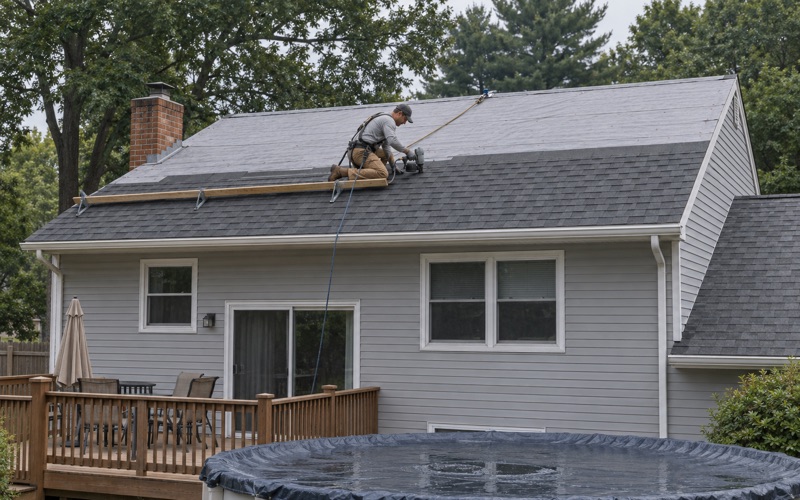
With the deck bare, the underlayment goes on fresh. We use ASTM D1970 self-adhering ice and water barrier at the eaves, in the valleys and around penetrations, and an ASTM D8257 synthetic underlayment across the rest of the field. Your written scope lists underlayment as its own line, so you can compare what two contractors are really proposing.
Ridge vent and soffit intake
Attic ventilation is one of the details a first replacement can correct. We check whether the soffits actually draw air or have been blocked by insulation, and we size a ridge vent to the intake so the net free area stays balanced. A hot, damp attic shows up as stained sheathing, which the tear-off often brings into plain view.
Ventilation is the line on an estimate that is easiest to skip and hardest to judge afterward. We describe what is there now, what we propose and why, in plain terms, before anything is scheduled. If the existing setup is already working, we say that too and leave it as it is.
Drip edge, flashing and pipe boots
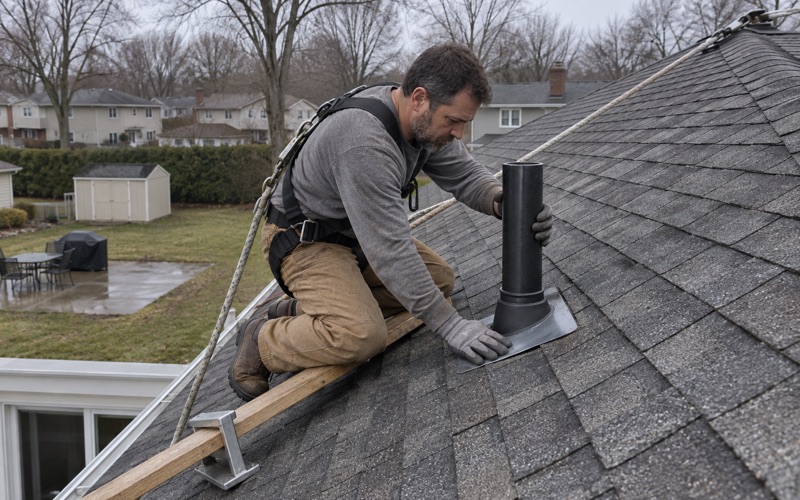
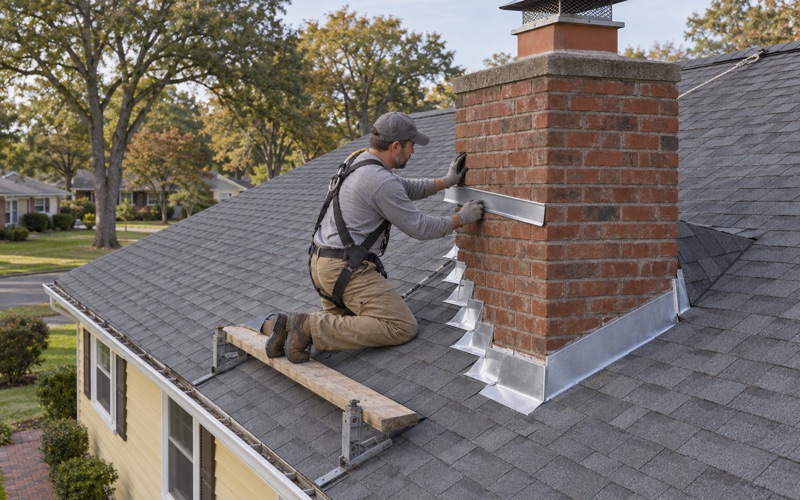
Edges and penetrations are where a replacement earns its keep. We install drip edge at the eaves and rakes, replace the pipe boots, and fit apron and kick-out flashing where a roof meets a wall. Step flashing and counter flashing at walls and chimneys are replaced, not caulked over, so new shingles never depend on tired metal.
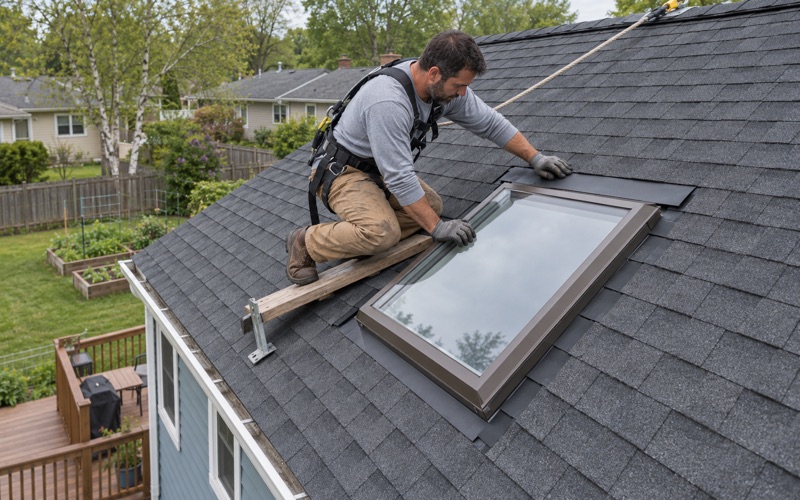
Skylights get the same care. A curb-mounted or deck-mounted unit is reflashed along with the new roof, and if the skylight itself is near the end of its useful life, we tell you before the shingles go on rather than after, when swapping it would mean opening the new roof.
A written scope you can compare
Every scope we write lists tear-off, decking, underlayment, flashing, ventilation and gutters as separate lines, so two estimates can sit side by side item by item. Our contracts follow New Jersey’s home improvement rules, including the written contract and the three-day cancellation notice. On a first replacement, that paper record is what you hand the next owner who asks what is on the roof.
- 20+ Years in Roofing
- Attic-First Leak Checks
- Line-Item Written Scopes