Vineland Elite Roofing has spent more than 20 years on roofing in Seabrook Farms and the rest of Upper Deerfield Township, and the first thing we settle on any call is who actually owns the roof. That sounds like an odd place to start, but here it decides who signs the contract, who sets the schedule, and who we report back to when the work is finished.
A leak call starts in the attic as well as on the shingles, because water rarely shows up on a ceiling directly under the spot where it gets in. We trace it to the real entry point first, then tell you plainly whether a repair will hold before replacement comes up at all. When a full roof is the honest answer, the written scope breaks out tear-off, decking, underlayment, flashing, ventilation and gutters line by line.
That itemized format helps anyone comparing two bids, and it helps even more when an owner has to justify the spending to someone else. Below we walk through how Seabrook’s housing came to be, what the old worker rows were built with, and how we approach roofs for a rental landlord and for a homeowner on a detached lot.
From Company Town to Countryside Village
A Town Where the Employer Owned the Houses
Seabrook Farms is named after Charles F. Seabrook, whose truck farm was one of the largest in New Jersey. Founded in 1917, the operation grew from 60 acres to 20,000 by 1922, and after 1934 it became famous for flash-freezing vegetables. In 1950 it was the largest agribusiness in the country, with more than 6,000 seasonal and permanent workers at its peak.
It was a company town in the full sense. A Rutgers exhibit puts it plainly: Seabrook owned the housing its workers lived in, and it also ran social services and the local school system. That history set a pattern that still matters for roofing, because the houses were planned, built and kept up as a group rather than one family at a time.
Wartime Rows and the People Who Lived in Them
During World War II, about 2,500 Japanese Americans lived in cinder-block barracks at Seabrook Village, and Italian, Estonian and Black workers followed in later years. The Seabrook Educational and Cultural Center collection, kept in the basement of the Upper Deerfield Township Municipal Building, holds much of that record.
The company went out of business in 1959, although Seabrook Brothers & Sons, founded in 1978, continues to process and freeze vegetables. The old barracks did not vanish with the company. They became subsidized apartments, and by 2006 several had been replaced as the township and a private developer prepared the first phase of a 283-unit project.
Countryside Village on Deerfield Drive
That project became Countryside Village at 99 Deerfield Drive in Seabrook: 283 rental apartments on a 34-acre site that was formerly the workforce housing property of the Seabrook Frozen Foods Company. It was completed between 2006 and 2008, and the units split into 52 one-bedroom, 128 two-bedroom and 103 three-bedroom homes.
The development is 100% affordable under 30-year controls, with professional on-site management and 24-hour maintenance. The New York Times described the first phase as two- and three-story townhouses, which is a very different set of roofs from the one-story rows that came before them.
Looking for roofing closer to Maurice River? See Roofing in Maurice River.
What the 1944 Worker Rows Were Built With
Concrete Block Under a Low Gable
A 1944 photograph caption describes the evacuee family housing in Seabrook village as built by the Federal Public Housing Authority, with single men and women assigned to dormitories the government built. The photo shows one-story concrete-block row housing under a low gable roof, with brick chimneys rising through it.
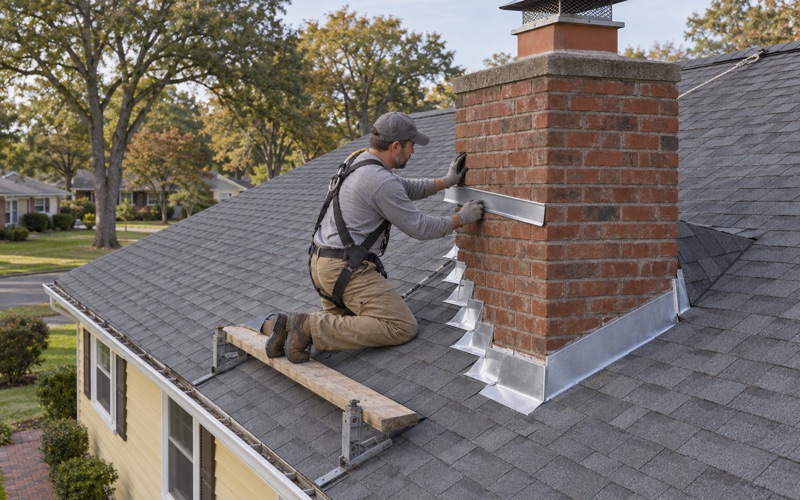
A low gable over a long masonry row is a simple shape, but it sheds water slowly and puts a lot of weight on the details. A chimney coming through a roof like that needs step flashing and counter flashing set into a reglet, and on the uphill side a chimney cricket to split the water around it.
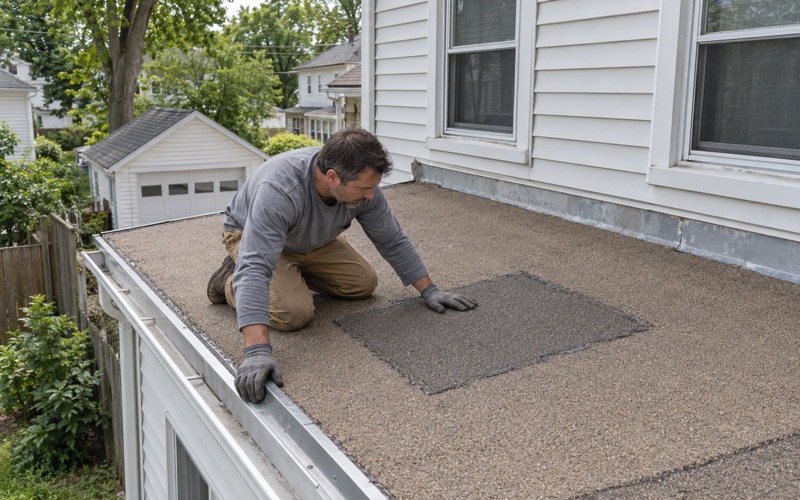
Low slopes over masonry also collect debris along the eaves, so drip edge at the eaves and rakes and a clear path into the gutters do real work. If we are asked to look at an older block building, those are the first details we check before anything else is discussed.
Prefabricated Houses in the Fields
Not every worker lived in block rows. A second caption records prefabricated houses in Field no. 16 that housed white Southern migrant workers in 1943 and 1944, and 209 former Crystal City detainees resettled at Seabrook after the war.
We mention these for context, not because we can point to any of them today. Whether the original 1940s buildings survive, and what roofs they carry, is not documented, so we never assume anything about a Seabrook house based on its street or its neighbors.
What the Census Count Still Shows
The American Community Survey counts 604 housing units in the Seabrook Farms CDP, and 93 of them date from the 1940s, with 22 more from 1939 or earlier. Another 64 were built in the 1950s and 110 in the 1970s, while 164 went up between 2000 and 2009 and 72 in 2020 or later.
The median year built is 1984, which says less than it seems, because the stock clusters in a few distinct building waves. When we look at a roof here, we judge it by what we find on the deck and in the attic, not by the decade the block around it suggests.
Roofs on Managed Rental Buildings: One Owner, Many Units
Rented Homes Are the Majority in the CDP
In the CDP, 331 of 579 occupied homes are rented, which works out to 57.2%. All 103 attached units, the 59 two-unit homes, the 53 homes in three-to-four-unit buildings and the 55 units in large buildings are rented, along with 61 detached houses.
That means many roofs in and around Seabrook answer to a landlord or a management office rather than to the family living under them. Mill Creek, formerly Seabrook East, adds to that picture: a family affordable rental project on Taft Street, Eisenhower Drive and MacArthur Drive, completed July 1, 2021.
How We Work With a Property Owner
A building owner with dozens of similar roofs needs something different from a homeowner with one. We write each scope with tear-off, decking, underlayment, flashing, ventilation and gutters as separate lines, so a manager can check our numbers against another bid and against their own capital plan item by item.
When the old roof comes off and the decking is bad, we photograph it and show it to the owner before replacing any, at the per-sheet price written into the contract. On a multi-unit job, that keeps decking surprises from turning into a dispute over a number nobody agreed to in advance.
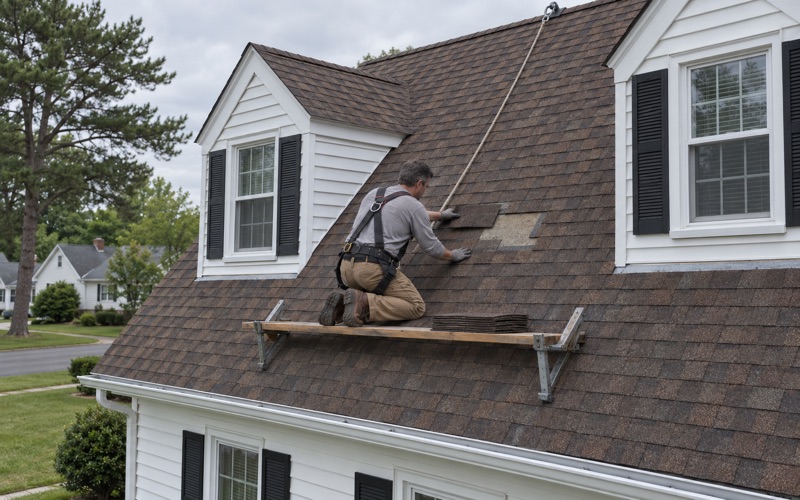
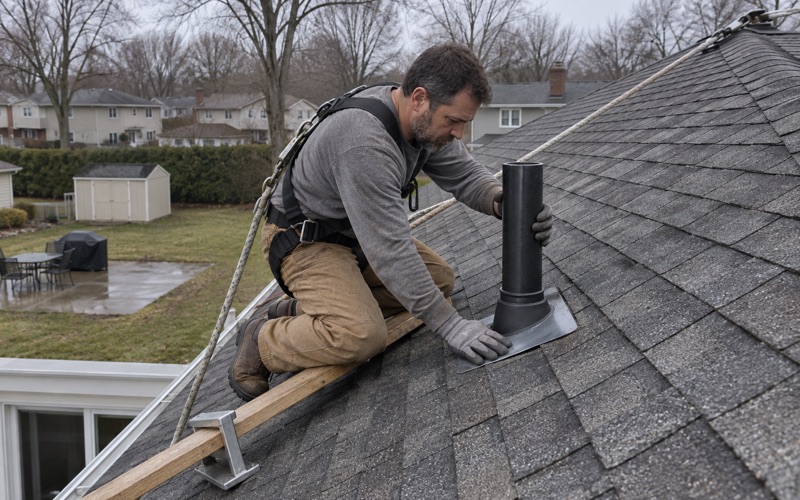
We also give a straight answer on repair versus replacement building by building, not a blanket recommendation for the whole property. Some roofs on a site may need a full tear-off while others only need a pipe boot or a section of flashing, and the scope should say which is which.
Tenants Living Under the Work
Rental roofs come with people in the units below, so the day has to end clean. We clean the yard, the driveway and the gutters at the close of each work day, and we run a magnet sweep for roofing nails where children play and cars park.
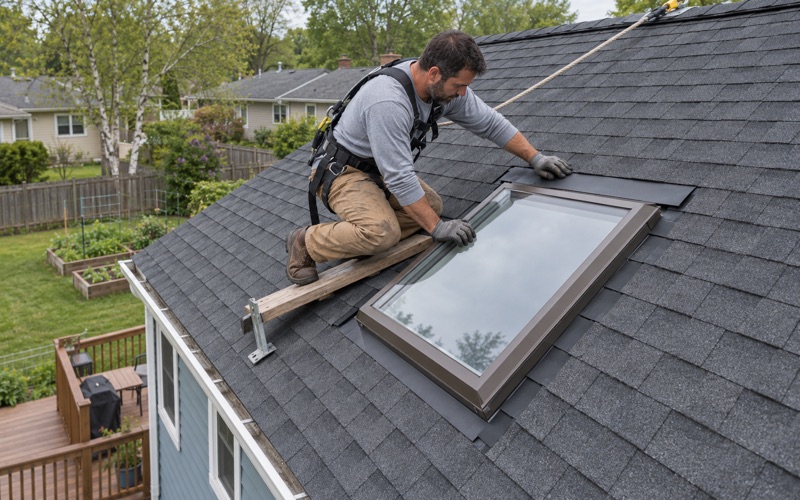
On attached townhouse rows, water that appears in one unit can start at a wall joint or a shared flashing line over the next. Flashing at walls, chimneys, skylights and where two roof planes meet is replaced, not caulked over, whenever we redo a roof, which matters on buildings where every unit shares those joints.
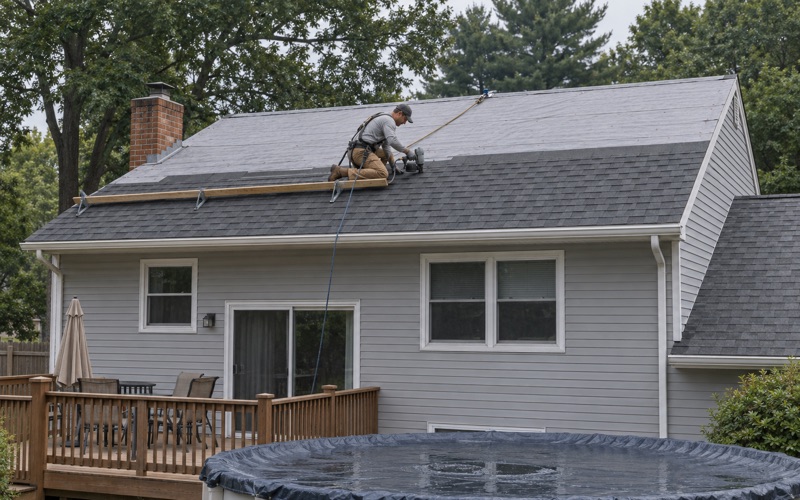
Scheduling across a row of occupied units is the other half of the job. We lay out which buildings come off on which days so the office can notify tenants ahead of time, and we keep each tear-off small enough to dry in the same day.
Owner-Occupied Houses and Seabrook Roofs Today
The Homeowners’ Share
Every owner-occupied home in the CDP is a detached house, 248 of them, according to the census tenure tables. For those owners we work directly for the person who lives there, and the conversation is about one roof, one budget and one set of choices.
Color is one of those choices. We bring shingle samples to the house and hold them up against the actual brick, stone or siding, since a swatch in a showroom rarely looks the same on a real wall. Architectural shingles such as GAF Timberline HDZ, Owens Corning Duration and CertainTeed Landmark all come in ranges worth comparing that way.
Ventilation is part of the same visit. A ridge vent only works with soffit intake to feed it, and we check the net free area of both before recommending a change to either, because an attic that cannot breathe wears out whatever goes on top of it.
Paperwork and Sign-Offs
Seabrook Farms is unincorporated, so the municipality that matters for records and approvals is Upper Deerfield Township in Cumberland County. Mail addresses read Seabrook, ZIP 08302, which is worth knowing when a contract and a township record have to match.
Our contracts follow New Jersey’s home improvement rules, including a written contract and the three-day cancellation notice. Where a full replacement counts as a capital improvement, the paperwork includes Form ST-8, the Certificate of Exempt Capital Improvement. If you have solar panels, their removal and reinstall go into the schedule from the start instead of being discovered on the morning of the tear-off.
Storms, Flood Maps and Forecasts
The area sits in National Weather Service forecast zone NJZ021, covered by the Mount Holly office, and that is a forecast zone rather than a climate record. On June 27, 2008, a storm report filed under Seabrook Farms read simply that trees and wires were down in Upper Deerfield Township.
When wind does that kind of damage, we photograph it and write it up for your own insurance claim, and we will meet the adjuster on site if you ask. For owners checking flood exposure, Upper Deerfield takes part in the FEMA flood program as community 340175A, with a current effective map dated June 16, 2016.
- 20+ Years in Roofing
- Attic-First Leak Checks
- Line-Item Written Scopes