Vineland Elite Roofing has handled roofing in Rosenhayn for more than 20 years, and nearly every call we take here comes from the person who owns the house and sleeps under the roof in question. That shapes how we work from the first visit. We check the attic as well as the shingles, so the price we give you is for the place water actually gets in, not a guess made from the driveway.
The next thing you hear from us is whether the roof can be repaired. Replacement only comes up after that answer, and when it does, our written scope breaks tear-off, decking, underlayment, flashing, ventilation and gutters into separate lines. You can set our estimate beside anyone else’s and compare the two item by item instead of weighing one total against another.
What follows covers what is particular about roofs in this village: who makes the call, which decades the houses come from, how chimneys and flashing behave on older heating setups, and how we weigh a repair against a full replacement when one household is paying for it.
One House, One Owner: How Roof Decisions Get Made Here
Rosenhayn is a census-designated place inside Deerfield Township, Cumberland County, and its housing is unusually uniform in one respect. The 2024 American Community Survey five-year estimates count 416 detached houses among 456 housing units, with no attached or mobile-home units at all. Of the 444 occupied homes, 369 are owner-occupied, and every one of those 369 is a detached house.
No Board, No Association, No Property Manager
That means a roof decision here rarely passes through a condo board, a homeowners’ association or a management company. The person who walks the yard with us is usually the person who signs the contract and pays for the work. Conversations are more direct as a result, and our answers have to hold up for someone who will live with the outcome for decades.
It also means nobody else is sharing the cost. A single household is weighing its roof against everything else the house needs that year, so we lay the options out plainly: a repair that buys real years, a partial fix that buys a few, or a replacement that resets the clock. Each one gets a price and an honest account of what it does and does not solve.
The Rented Houses
The same survey counts 75 renter-occupied homes: 35 detached houses and 40 units in two-unit buildings. On those, the owner and the occupant are different people, so we arrange access with the tenant, report findings to the owner, and send photos of the attic and roof surface so a landlord who lives elsewhere can see exactly what we saw.
Contracts and Permits
Our contracts follow New Jersey’s home improvement rules, including the written contract and the three-day cancellation notice. The state’s Contractors’ Business Registration Act requires home improvement contractors to register, and it is reasonable to ask any roofer for that number before you sign anything.
On permits, repair or replacement of the roof covering on a detached one- or two-family house counts as ordinary maintenance under N.J.A.C. 5:23-2.7, so a straight re-roof of shingles needs no permit. Work affecting structure or fire safety is excluded from that rule, so a sagging rafter or a cut-in skylight opening goes through the normal permit process instead.
Looking for roofing closer to Pittsgrove? See Roofing Services in Pittsgrove.
From Farm Colony Beginnings to 1950s and 1970s Houses
Rosenhayn grew on land first settled as a Jewish agricultural colony on the New Jersey Southern Railroad. After six families sent in 1883 soon left, Jewish families began buying land in 1887, and 37 more settled in 1888, obliged to build houses and cultivate part of their land within a set time. By late 1889, 67 families lived in 23 houses on 1,912 acres.
How many of those early houses survive, and what sits on their roofs now, is not something any record we have can answer. What the census does show is a housing stock spread across decades rather than built in a single push, with a median year built of 1974. That spread changes what we expect to find once the shingles come off.
Houses Built Before 1940
The survey counts 34 units from before 1940. Houses of that age often sit on board sheathing rather than plywood, with gaps between the planks and rafters spaced by the carpenter’s judgment rather than a modern table. New shingles need a sound, flat nailing surface, so the deck is the first thing we look at closely.
When the old roof is off and a board or sheet is rotted or split, we photograph it and show it to you before anything is replaced. The per-sheet price for new decking is written into the contract ahead of time, so a bad section of deck never turns into an open-ended surprise on the final invoice.
The 1950s and 1970s Houses
The two largest groups in the village are 103 units from the 1950s and 111 from the 1970s. Many houses of these decades were built with small gable vents or a few box vents and little thought for intake air. Later insulation upgrades sometimes buried the soffits entirely, which traps heat and moisture in the attic.
On a replacement we balance the system with a ridge vent and soffit intake sized by net free area, so air enters low and leaves high. The attic visit tells us whether the soffits are open, whether the decking shows moisture staining, and whether the vents already in place are doing anything useful.
The 1980s and Newer Houses
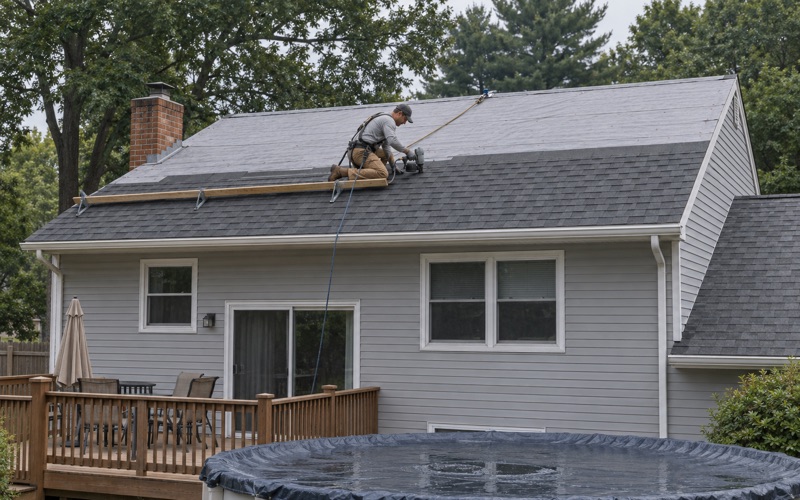
Another 81 units date from the 1980s, and 57 more were built from 2000 onward. These houses usually have plywood or OSB decking and are on their first or second roof. A new roof here typically means synthetic underlayment meeting ASTM D8257, ASTM D1970 self-adhering ice and water barrier at the eaves and valleys, and drip edge at the eaves and rakes.
For shingles, most owners choose architectural laminated lines such as GAF Timberline HDZ, Owens Corning Duration or CertainTeed Landmark. We pick the color with you at the house itself, holding samples up against your brick, stone or siding, because a swatch that looks right on a screen often reads differently in daylight beside real walls.
The Garton Road Shul: An Old Gabled Roof Still in Use
The colony’s surviving landmark is the Rosenhayn Synagogue, Congregation Or Yisroel, known locally as the Garton Road Shul, at 600 Garton Road. The congregation was established in 1888, and the wooden, gabled, clapboard building was completed around 1898. It remains an active Orthodox congregation cared for by the Ostroff family.
It is also one of fewer than 100 surviving 19th-century synagogue buildings in the United States. We have never worked on it, and we mention it because it shows how long a plain gabled roof over a wood frame can stay in service when it is looked after.
Why a Simple Gable Holds Up
A gable roof has two slopes meeting at one ridge, with no valleys or hips to collect water. Rain moves straight down each slope and off the eaves, which leaves fewer joints where a leak can start. The weak points are the edges: the rakes, where wind gets under the first course, and the eaves, where water and ice sit longest.
That is why we run drip edge at both and set ice and water barrier along the eaves on a gabled replacement. On a plain roof, those edges do most of the work, and getting them right matters more than any upgrade to the field shingles.
Clapboard Walls and Roof Lines
Wherever a roof slope runs into a wood clapboard wall, as it does at a dormer or a lower addition, water follows the wall down to the roof edge. Without a kick-out flashing at the bottom of that run, it pours behind the siding and rots the sheathing and trim, often out of sight until the wall is soft.
We install step flashing up the wall and a kick-out at the base on every roof where a slope meets siding. On an older wood house, that small bent piece of metal often decides whether the clapboard below lasts for decades or needs replacing within a few years.
Fuel-Oil Chimneys, Flashing and the Repair-or-Replace Call
Most homes here heat with utility gas, but the survey counts 62 of 444 occupied homes on fuel oil and 23 on bottled gas. An oil-fired boiler or furnace generally vents through a masonry chimney, so a good share of houses still carry one, and the chimney is the most common source of the leaks we trace.
Chimney Flashing Done Properly
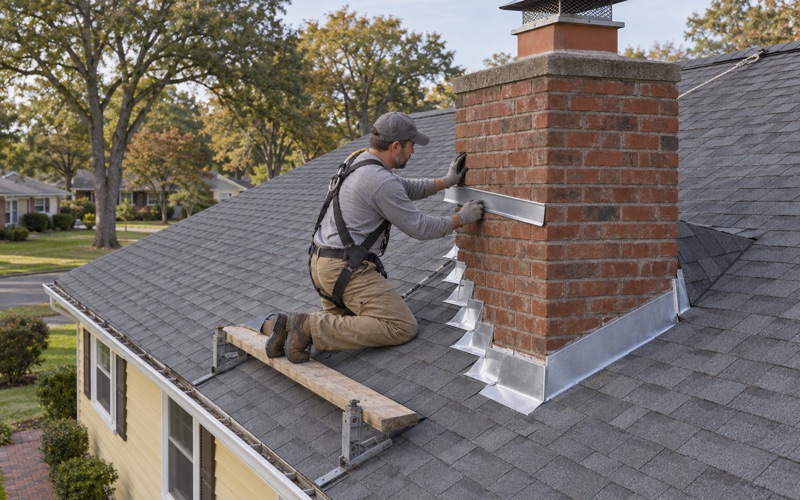
A chimney needs step flashing woven into the shingle courses and counter flashing set into a reglet cut in the masonry, so the two overlap and shed water without relying on sealant. A wide chimney on the slope also needs a cricket, a small peaked saddle on the uphill side, to split the water around it instead of letting it pool.
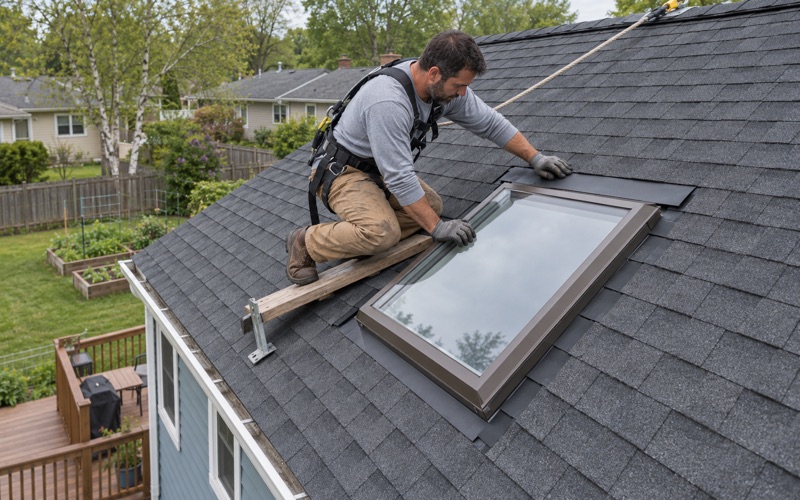
When we redo a roof, flashing at chimneys, walls, skylights and anywhere two roofs meet is replaced, not caulked over. Caulk on a chimney is a sign of a past shortcut, and it is usually where the attic stain lines up when we look from below.
When a Repair Is the Right Answer
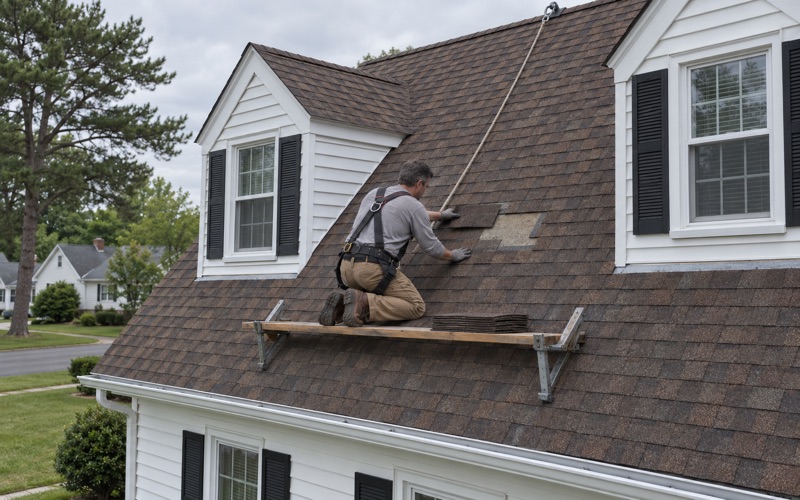
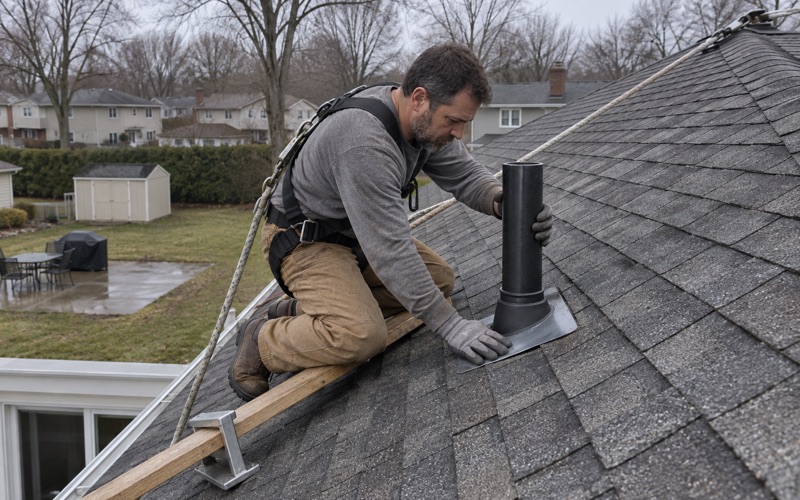
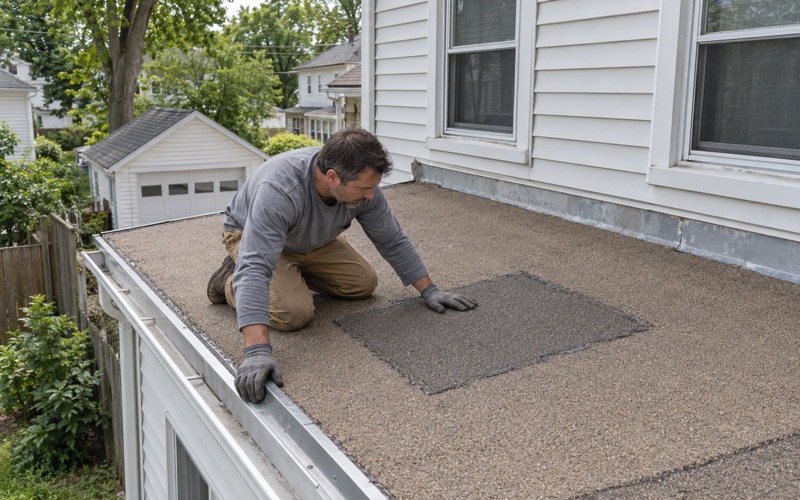
A lot of leaks come from one place: a cracked pipe boot, a few shingles torn loose at a rake, or one failed flashing joint at the chimney. If the rest of the roof is lying flat, holding its granules and dry from the attic side, a targeted repair is the sensible spend, and we will tell you so.
The attic check is what makes that call reliable. Water often runs along a rafter before it drips, so the stain on your ceiling can sit several feet from the actual entry point. Tracing it from inside keeps us from replacing a section of roof that was never the problem.
When Replacement Makes More Sense
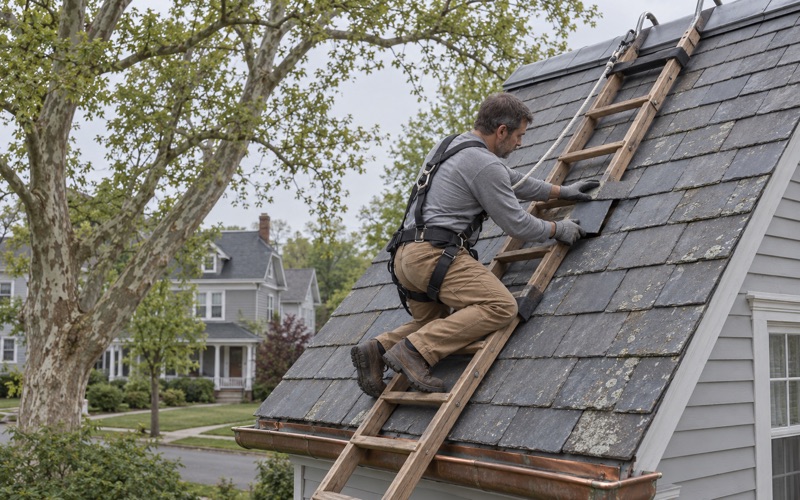
Replacement starts to win when the leaks are in several places, when shingles are curling or bare across whole slopes, or when the deck feels soft underfoot. At that point repairs chase symptoms, and the money goes further on a new roof with fresh underlayment, flashing and ventilation.
If panels are on the roof, we plan the solar removal and reinstall into the schedule before work starts. If a storm caused the damage, we photograph it and write it up for your own claim, and the crew will meet the adjuster on site if you ask. At the end of each work day we clean the yard, driveway and gutters and run a magnet sweep for nails.
- 20+ Years in Roofing
- Attic-First Leak Checks
- Line-Item Written Scopes