
Vineland Elite Roofing handles roof repair in Vineland, NJ, serving surrounding cities including Buena, Millville, Buena Vista, Rosenhayn and Pittsgrove. After more than 20 years of fixing leaks, lifted shingles and failed flashing, we have learned that most roofs which seem to need replacing actually need one or two problems found and fixed properly. Our job on a repair call is to find those problems, explain them and fix them so they stay fixed.
Every repair visit includes a look in the attic as well as on the roof. Water rarely enters directly above the stain it leaves, so tracing it along the rafters and sheathing to the point where it actually gets in is what keeps a repair from missing its target. Nothing is priced until we know where the water is coming from.
You also get a straight answer on whether the roof can be repaired before replacement is ever mentioned. If a repair will hold, that is what we quote, in writing, with the materials and the scope spelled out. If it will not, we show you why with photos from the roof and the attic, and leave the decision with you.
Residential Roof Repair
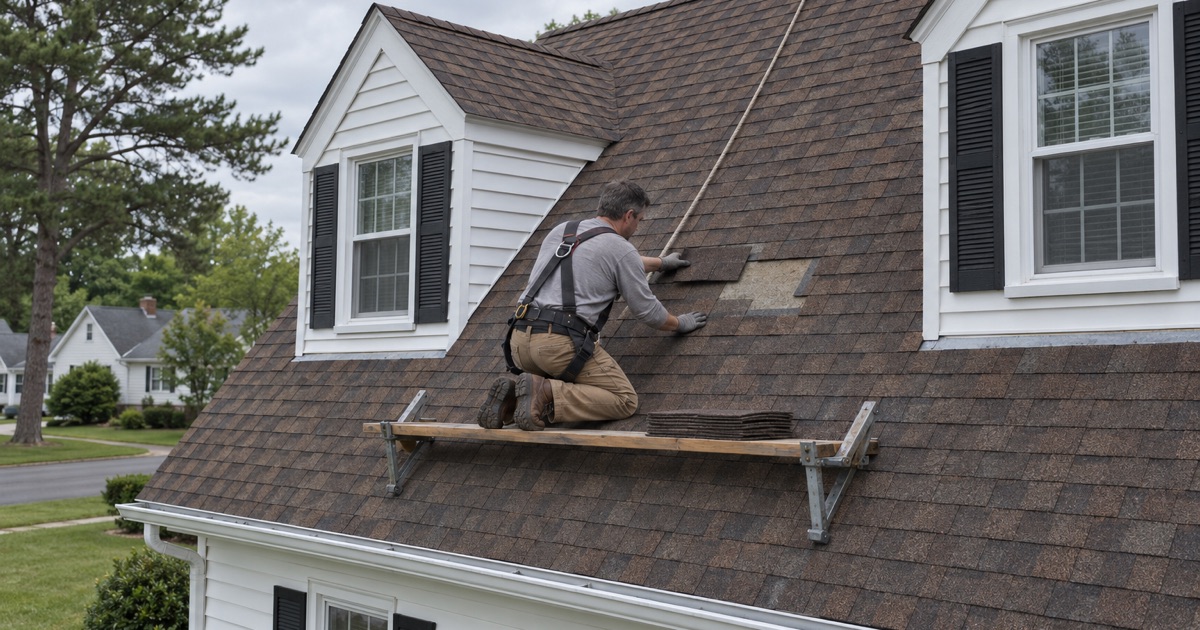
Shingle Repairs After Wind
Wind damage on an asphalt roof often looks smaller from the ground than it is. A gust can break the adhesive strip under a row of tabs, fold them back and drop them into place again, leaving a crease and an unsealed edge that the next storm will lift completely. We check each slope for creased, cracked and unsealed tabs, not just the shingles that ended up in the yard.
Replacement shingles are matched to the existing roof by brand, line and color wherever the product is still made. They are nailed to the manufacturer’s pattern and sealed into the course above, so the repaired section sheds water the same way as the rest of the roof. On an older roof we tell you honestly how close the color will look once it is up.
Flashing at Chimneys, Walls and Valleys
Flashing is the metal that seals the joints where a roof meets a chimney, a wall or another roof, and it fails more often than the shingles around it. Step flashing pulls away from a sidewall, counter flashing works loose from the mortar of a chimney, and valley metal corrodes or gets cut by a careless nail. Each one lets water past shingles that otherwise look fine.
We replace failed flashing rather than caulking over it. That means lifting the shingles around the joint, installing new step flashing woven into each course and setting counter flashing into a cut reglet or mortar joint above it. Where a wide chimney has no cricket on its upslope side, we explain why one would help and price it as a separate line.
Pipe Boots, Vents and Small Penetrations
The rubber collar around a plumbing vent pipe is one of the most common leak points on any roof. Sun and heat dry the rubber until it cracks, and water runs down the pipe into the attic, often showing up as a stain in a bathroom or hallway ceiling. Roof vents, exhaust caps and satellite mounts fail the same way at their seals and fasteners.
We replace cracked pipe boots with new ones lapped correctly into the shingles, reseat or replace loose vents, and seal or remove old mounting holes from equipment that is no longer there. These are small jobs, but they account for a large share of the leaks we trace, and fixing them properly costs far less than the ceiling repairs they cause.
Commercial and Low-Slope Roof Repair
Membrane Seams and Punctures
Flat and low-slope roofs on storefronts, offices and apartment buildings rely on a continuous membrane, whether EPDM rubber, TPO or PVC single-ply, or torch-down SBS or APP modified bitumen. Most leaks start at a seam that has opened, a puncture from foot traffic or dropped tools, or a blister where moisture has collected under the surface. Because water spreads sideways on a flat roof, the leak inside can be well away from the damage.
We locate the failure by working outward from the interior leak and checking seams, laps and penetrations in the area. Repairs are made with materials compatible with the existing membrane, whether that means a heat-welded patch on TPO, a primed and taped patch on EPDM or a torched patch on modified bitumen. Mixing incompatible materials is a common reason flat roof repairs fail early.
Edges, Drains and Scuppers
Water on a flat roof has to leave through drains, scuppers or gutters, and anything that slows it down puts the membrane under standing water. Clogged drains, edge metal that has pulled loose and scuppers sealed with old caulk are frequent sources of leaks along the perimeter. Ponding water left for days also accelerates wear on the membrane around it.
We clear and reseal drains, refasten or replace loose edge metal and rebuild scupper flashings with new membrane and sealant. Where ponding is caused by a sag in the deck rather than a blocked drain, we tell you so, because the repair then needs to address the slope as well as the surface. Commercial repairs are scheduled around tenants and business hours where possible.
Rooftop Units and Curbs
Heating and cooling units, exhaust fans and skylights on commercial roofs sit on raised curbs, and the flashing around each curb is a common leak point. Service technicians walking to and from the units can also damage the membrane along their path. Old units that have been removed sometimes leave poorly patched openings behind them.
We reflash curbs with new membrane run up the sides and under the cap flashing, repair worn traffic paths and properly close any abandoned openings. When we find damage around a unit, we photograph it so the building owner or manager can share it with their mechanical contractor. Clear records make it easier to keep the next repair from being blamed on the wrong trade.
How We Decide a Repair Will Hold
Reading the Attic
The attic tells us things the roof surface cannot. Dark streaks on the rafters, rusted nail tips, damp insulation and daylight around a pipe all point to where water or air is getting through. Frost on the nails in winter or heavy staining across a whole slope can mean ventilation is part of the problem, not just a single leak.
We check the soffit intake and the ridge or roof vents while we are up there, because a poorly ventilated attic can produce condensation that looks exactly like a roof leak. If the water is coming from a bathroom fan venting into the attic or a plumbing line, we tell you that too, rather than selling a roof repair that will not stop it.
Signs a Repair Is the Right Call
A repair makes sense when the damage is confined to one area and the roof around it is still healthy. Shingles that lie flat, hold most of their granules and still bend without cracking have years left in them. The same goes for a flat roof membrane that is still flexible and well adhered away from the damaged spot.
In those cases we quote the repair and nothing more. The written price lists the materials, the area being worked on and what is being replaced, so you know exactly what you are paying for. A roof with life left in it deserves to be fixed, not replaced because replacement is the larger sale.
When We Recommend Replacement Instead
Some roofs are past the point where repairs make sense. Leaks in several unrelated places, widespread granule loss, curling or brittle shingles and soft decking across large areas all mean that each repair only buys a short time before the next leak. Repeated repairs on a roof like that end up costing more than replacing it.
When we see that, we say so plainly and show you the photos. We will still make a temporary repair if you need time to plan, and we explain what a replacement would involve so you can compare it with other estimates. The choice stays with you, made on what is actually on the roof.
Roof Repair Rules and Paperwork in New Jersey
Ordinary Maintenance on One- and Two-Family Homes
New Jersey treats repair or replacement of the existing roof covering on a detached one- or two-family house as ordinary maintenance under N.J.A.C. 5:23-2.7, so no construction permit is needed. That exemption does not cover work that affects structural or fire safety, such as replacing damaged rafters. Apartment buildings and commercial buildings also fall outside it.
We check which category your repair falls into before the work is scheduled. If a repair turns out to involve framing, we stop, show you the damage and explain what the next step requires. That way the paperwork matches the work and nothing has to be undone later.
Written Contracts and Clear Prices
Every repair is priced in writing before work begins, and our contracts follow New Jersey’s home improvement rules, including the written contract and the three-day cancellation notice. The scope lists what is being repaired, the materials being used and any parts of the roof we are not touching. If we find something unexpected once we open the roof, we stop and talk to you before going further.
At the end of the visit, the yard, driveway and gutters are cleaned and the ground is swept with a magnet for roofing nails. You get photos of the finished repair, which are useful if you sell the house or need to show a later buyer or insurer what was done.
- 20+ Years in Roofing
- Attic-First Leak Checks
- Line-Item Written Scopes