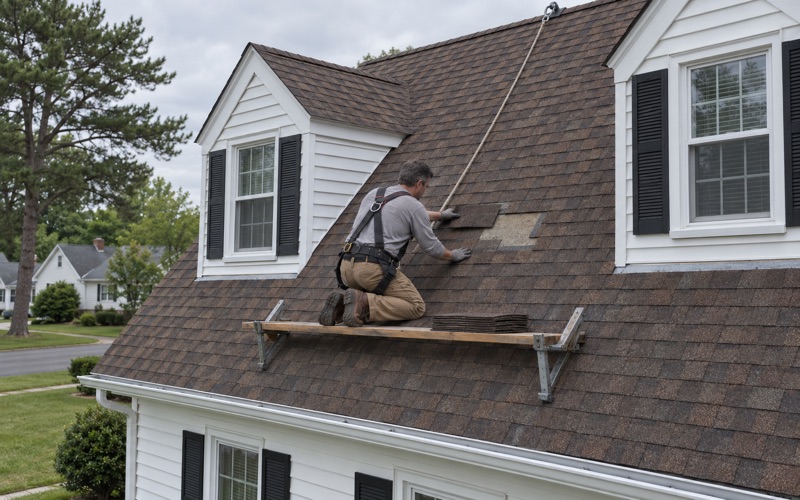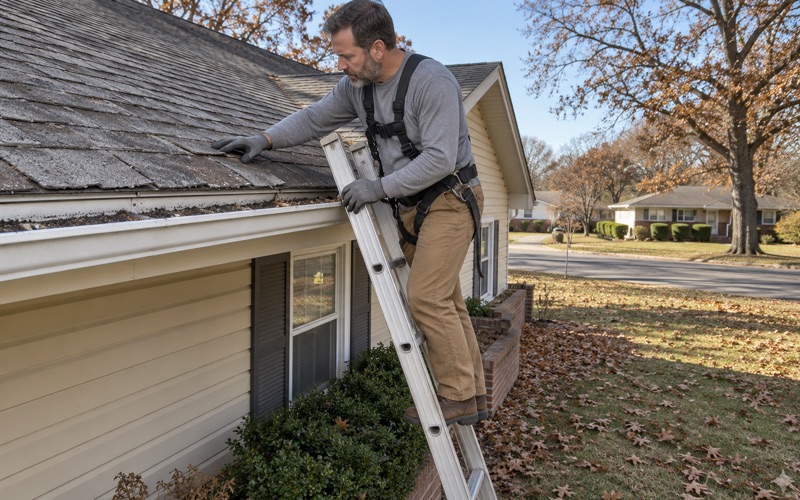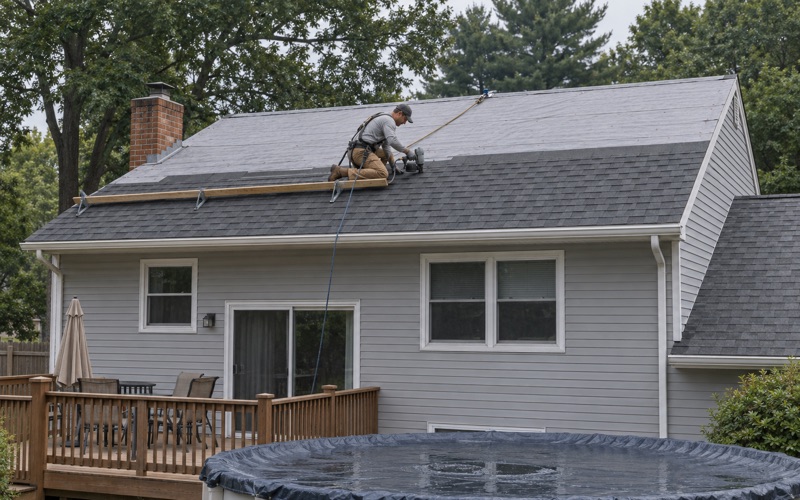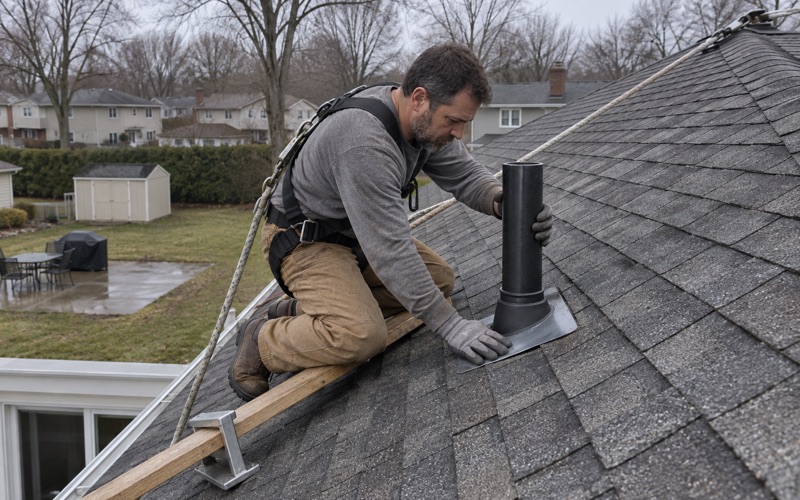
Vineland Elite Roofing brings more than 20 years in the trade to roofing in Middle Township, and on a good share of calls here the opening question has nothing to do with shingles. When a house sits inside a 55-and-over community, the roof may be the owner’s responsibility or the association’s, and the community’s declaration is what settles it. We find that out first, before anything is measured or priced.
That order saves everyone time. An owner who books an estimate for a roof the association controls can end up holding a quote nobody is allowed to act on, while an owner who waits on a board that has no say over the roof can lose a season. Once responsibility is clear, the rest of the visit runs the way it does anywhere else for us.
On a leak call, that means we look in the attic as well as on the roof, tracing the water to where it actually gets in before pricing anything. Then you get a plain answer on whether a repair will hold, and replacement only comes up after that. For a home outside any association, the same visit simply starts one step later.
Owner or Association: Who Decides on a Middle Township Roof
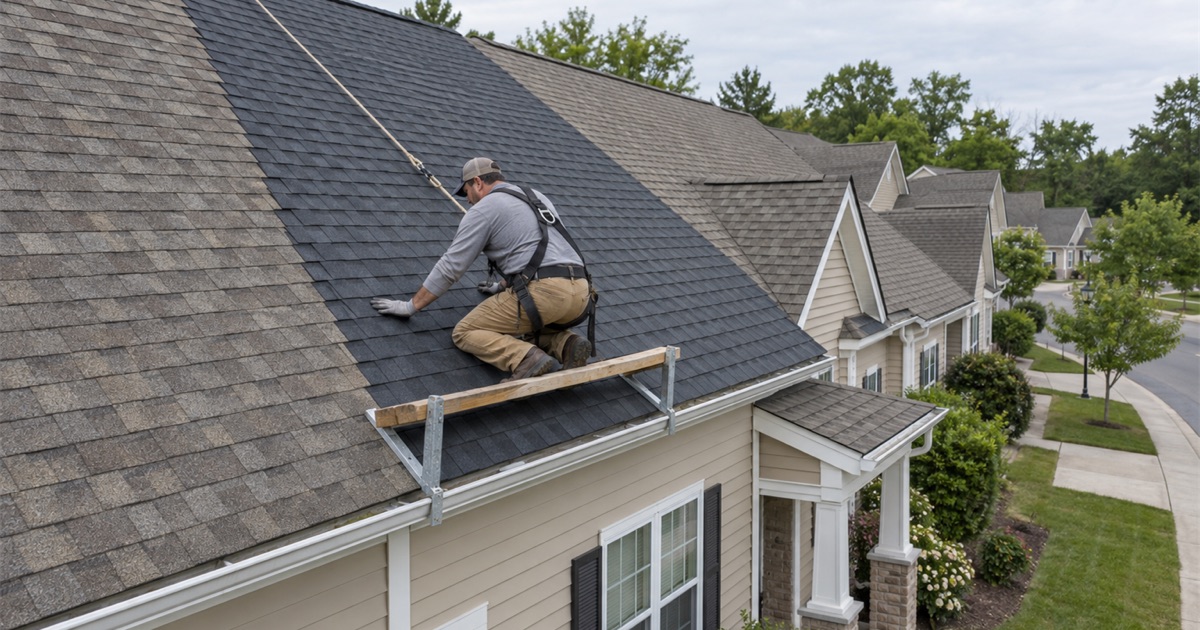
Why the declaration comes before the estimate
An age-restricted community is set up by a declaration, and that document is where the line between an owner’s property and the association’s common elements is drawn. Some adult communities put the roof on the association’s side and some put it on the owner’s. We have not read the declarations for the communities in Middle Township, so we never assume which way any one of them falls.
What we do instead is ask. If you have your closing documents, the declaration or the association’s rules should say who maintains the roof, who replaces it and who approves the color or material. If the language is unclear, the management office is the place to confirm it before any work is put on the calendar.
What we ask on the first call
Before we drive out, we ask three things: whether the home is in an association, whether you have checked the declaration, and whether the board has already hired a contractor for the community. The answers change what the visit is for. Sometimes it is a full estimate, and sometimes it is an inspection and a written condition report you can take to the board.
A condition report from us describes what we saw on the roof and in the attic, with photographs, so the owner and the association are looking at the same evidence. It does not decide responsibility. It gives whoever holds the roof under the declaration a clear picture of what needs attention and where the water appears to be coming in.
When the decision belongs to the board
If the declaration puts the roof with the association, our part with an individual owner is usually limited to documenting a problem so it can be reported. Where an association asks us to quote, the scope is the same one an owner would get: tear-off, decking, underlayment, flashing, ventilation and gutters on separate lines, so a board comparing bids can set them side by side.
Shingle color in a 55+ community may be fixed by the association rather than chosen house by house, and the rules will say which. Where the owner does have the choice, we hold samples up against the brick, stone or siding on the actual home rather than picking from a brochure, and we check the community’s rules before suggesting anything that stands out from the street.
Looking for roofing closer to Bellmawr? See Bellmawr Roofing.
Legacy at Cape May and the Rio Grande Neighborhood
141 homes built from 2007 to 2014
Legacy at Cape May, in Rio Grande, is a 55-and-over community of 141 homes built between 2007 and 2014, according to 55places, with Lennar starting the work in 2007 and Ryan Homes building from 2010. Rio Grande counted 3,610 residents in 2020 and is one of the census-designated places that together make up Middle Township.
Two builders over seven years means the roofs at Legacy were not all installed at once or necessarily by the same crews. When we look at one, we note the shingle line, the underlayment visible at the edges and the flashing details, rather than assuming the house next door was put together the same way.
Attached or single-family: we settle it at the house
The 55places listing describes Legacy at Cape May as attached, while its own text calls the homes single-family. We do not treat either description as settled. The difference matters for a roof, because a roof line shared between two units raises questions about where one owner’s work stops and the neighbor’s begins, and a detached home does not.
So the first thing we do at a Legacy address is look at the building itself. If the roof is continuous with another unit, the scope has to say exactly where the tie-in falls and how the transition will be flashed and sealed. If the house stands alone, the job is planned like any other detached home.
Dues and what they may or may not cover
The same listing gives monthly dues of $274 to $420 at Legacy at Cape May, but it does not say what those dues cover. The dues figure alone tells you nothing about the roof. A community could fund roofing from its reserves or leave it entirely to owners, and only the declaration answers that question for a given home.
If you are buying into Legacy or another Rio Grande community and want to know where the roof stands, we can inspect it and give you a written description of its condition. That gives you something concrete to set beside the association’s documents when you work out what you would be responsible for after closing.
Cape May Court House: Four Seasons, Wynndemere and the County Seat
Four Seasons at Stone Harbor and Wynndemere
Cape May Court House holds two more of the township’s 55+ communities, Four Seasons at Stone Harbor and Wynndemere, both named by 55places. A listing for 62 Wynndemere Court described it as one of the section’s most desirable 55+ neighborhoods. As with Legacy, we have not read either community’s declaration, so roof responsibility is the first thing we confirm.
Because these communities sit close together, owners sometimes compare notes and assume their rules match. They may not. Two age-restricted associations a short drive apart can divide roof responsibility differently, and the only safe comparison is between the two declarations, not between neighbors’ experiences.
Houses around the county seat
Cape May Court House is a section of Middle Township and the county seat of Cape May County, with 5,573 residents in 2020. It is not a separate town, and it is not the City of Cape May. The Old Cape May County Courthouse, completed in 1850, is on the National Register, but no historic district centered on the section turned up in our research.
Around the county seat you will find houses of many ages, and the township’s housing includes 554 units built in 1939 or earlier. An older house can hide soft or rotted decking under its current roof. When that turns up once the shingles are off, we photograph it and show you before it is replaced, at the per-sheet price written into the contract.
Storms and the Cape May forecast zone
Cape May Court House falls in the National Weather Service’s Cape May forecast zone, NJZ023, covered by the Mount Holly office. That is a forecast zone rather than a climate record, but it is the zone whose watches and warnings apply here. After a storm, we photograph the damage and write it up for your own claim, and we will meet the adjuster on site if you ask.
Detached, Attached and Newer Homes Across Middle Township
Detached houses and ordinary maintenance
The Census count shows 7,255 single-family detached units out of 10,381 in the township. Under N.J.A.C. 5:23-2.7, replacing the roof covering on a detached one- or two-family house is ordinary maintenance in New Jersey and does not need a permit. That keeps a straightforward re-roof on a detached home simple on paper.
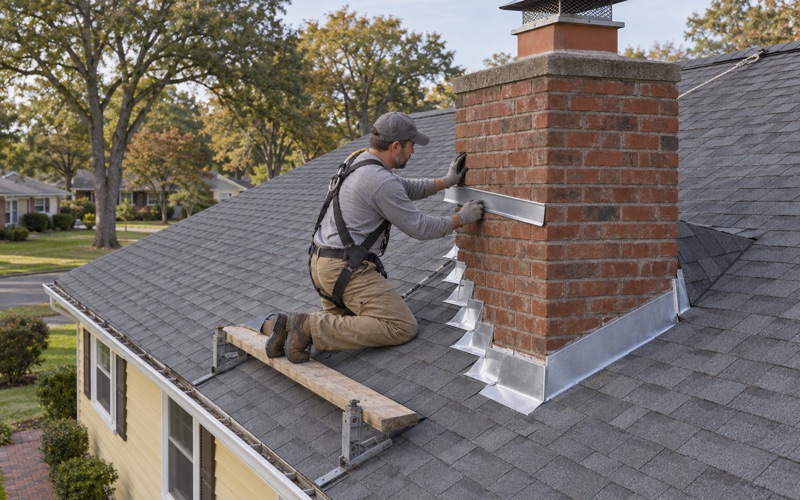
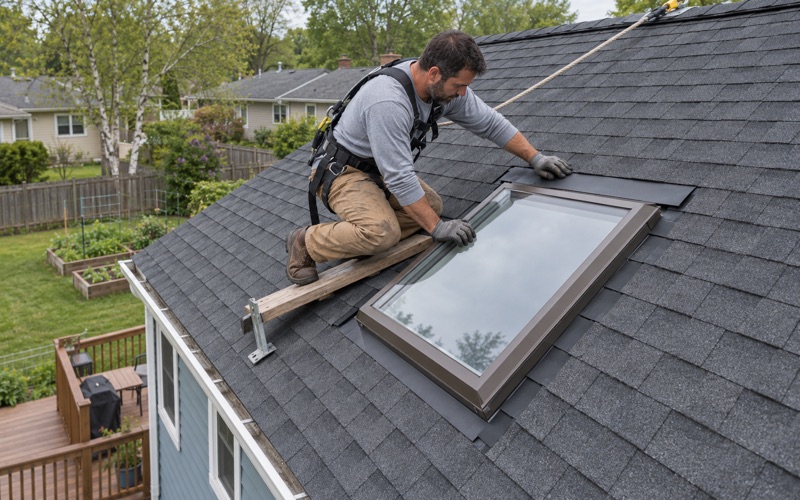
Simple on paper does not mean simple on the roof. We still check the decking, replace the flashing at chimneys, walls, skylights and wherever two roofs meet rather than caulking over it, and confirm the intake and exhaust ventilation work together. The written contract follows the state’s home improvement rules, including the three-day cancellation notice.
Attached units fall outside that clause
The same Census count shows 933 single-family attached units in Middle Township, 431 of them owner-occupied and 333 rented. The ordinary-maintenance clause covers detached one- and two-family dwellings, so attached units fall outside it. Before we schedule work on an attached home, we confirm with the township what it requires so the job does not stall partway through.
Attached units also bring the shared-roof questions we raised at Legacy. Where two owners share a roof plane, the scope has to say where our work ends, how the transition to the neighbor’s roof is sealed and flashed, and what happens if their side turns out to need attention as well.
Newer homes and the wind question
Much of the township’s housing is recent: 1,996 units were built between 2000 and 2009, 1,093 between 2010 and 2019 and 387 since 2020. A newer roof can still leak, often at a pipe boot, a skylight or a wall flashing, and the attic check is how we tell an installation detail from a failing shingle.
Wind is the other question owners raise. New Jersey sets design wind speed by address rather than by town, so we look it up for your property instead of quoting one figure for the whole township. Shingles tested to ASTM D3161 Class F or ASTM D7158 Class H are among the options we can discuss once that is known.
Seasonal homes and work while you are away
Not every owner here is in residence year-round. The Census counts 1,262 homes in Middle Township held for seasonal, recreational or occasional use, and some of those owners ask us to schedule work while they are away. We clean the yard, driveway and gutters at the end of each work day, magnet sweep for nails included, so the property is in order whether or not anyone is there to see it.
- 20+ Years in Roofing
- Attic-First Leak Checks
- Line-Item Written Scopes