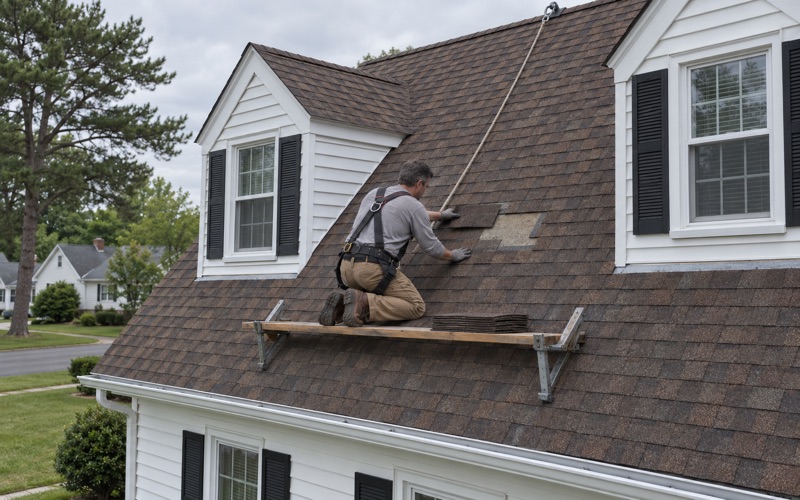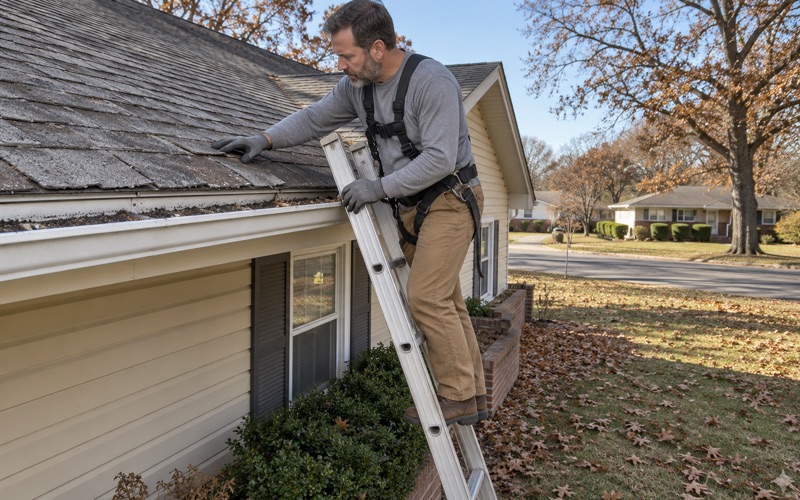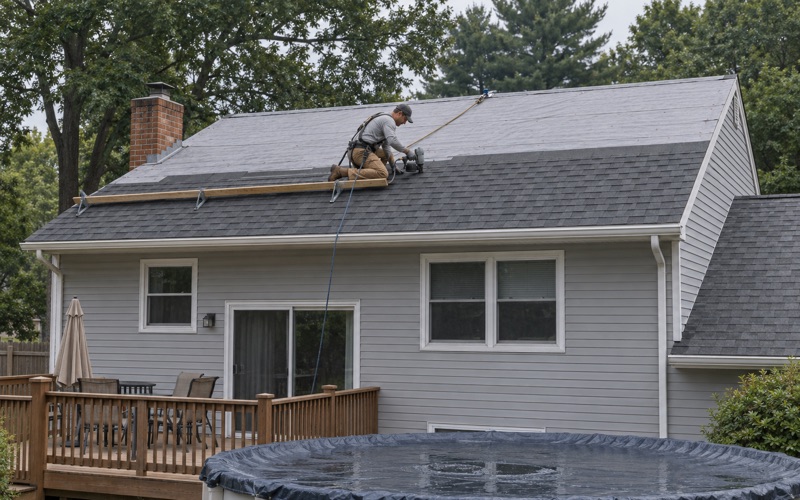
Vineland Elite Roofing has spent more than 20 years on roofing in Laurel Lake and the surrounding part of Cumberland County, and on a lot of houses here the job starts at the chimney. A roof in this community is rarely a plain field of shingles. More often it is shingles wrapped around a masonry stack or a metal flue that still carries heat out of the house every winter, and every repair we price accounts for it.
When a leak call comes in, we look in the attic as well as on the roof, because water that shows up on a ceiling near a chimney has often traveled along a rafter from somewhere else. Tracing it first is what lets us tell you honestly whether a repair will hold. If it will, that is the answer you get, and replacement only comes up when the roof truly needs it.
When a replacement is the right call, the written scope breaks out tear-off, decking, underlayment, flashing, ventilation and gutters on separate lines. That makes it easy to set our estimate next to anyone else’s and compare the chimney work item by item, which is where cheaper bids tend to cut corners. Our contracts follow New Jersey’s home improvement rules, with the written contract and the three-day cancellation notice included.
Oil and Wood Heat Keep Laurel Lake Chimneys in Service
Laurel Lake has not moved entirely to the gas main. American Community Survey figures (2024 five-year estimates) show 824 of the 1,142 occupied homes heating with utility gas, but 168 heat with fuel oil or kerosene, 46 burn wood and 27 run on bottled gas. That is a meaningful share of households whose heat depends on something venting up and out through the roof.
No source counts chimneys here, and we will not pretend to know how many roofs carry one. The link is an inference: oil burners and wood stoves ordinarily vent through a chimney or flue that passes through the roof. If your house burns fuel on site, the penetration that carries the exhaust is part of your roof and has to be treated that way.
Fuel Oil Burners and Their Chimneys
A house on fuel oil usually sends its burner exhaust up a masonry chimney or a lined flue. That chimney runs warm through the heating months, and the joint where it meets the shingles takes the movement of brick, mortar and roof deck expanding at different rates. It is one of the most common places we find water getting into an older house.
Because the chimney stays in service, we cannot treat it as a dead feature to be roofed around and forgotten. We look at the brick and crown where the roof meets them, note anything that belongs to a mason rather than a roofer, and tell you plainly. We do not sweep chimneys or work inside the flue; our job is the roof and everything that seals to it.
Wood Stove Pipes Through the Roof
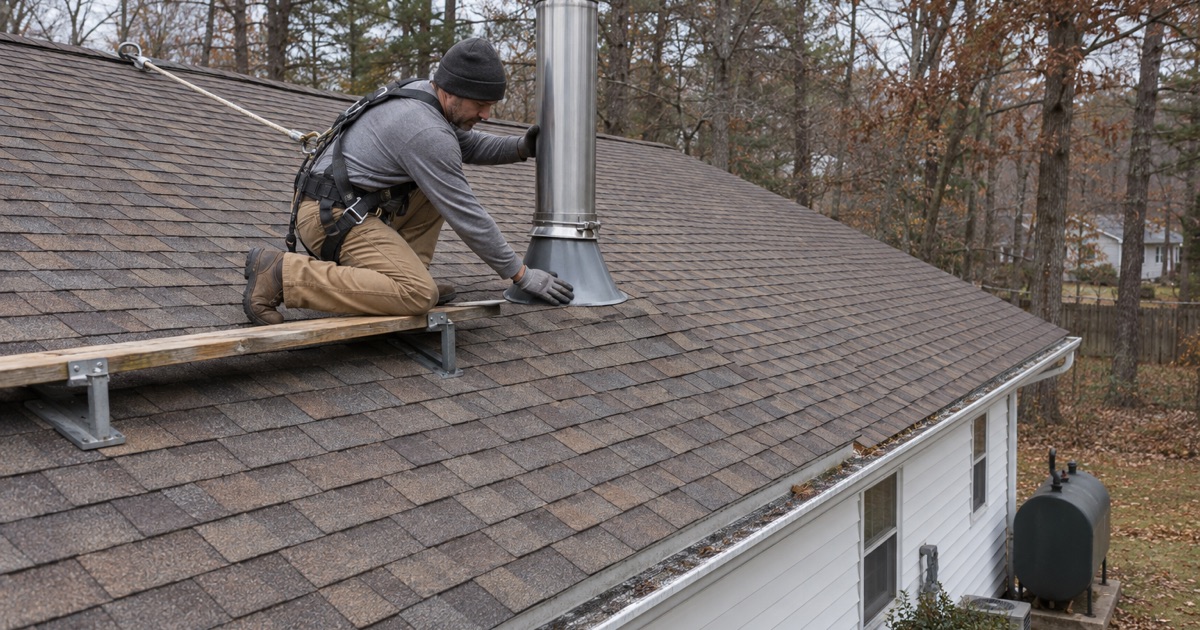
A wood stove often vents through a factory-built metal chimney rather than masonry, and that pipe passes through the roof with its own flashing collar and storm collar. Those parts sit right where the shingles have to lap them correctly. A collar that has shifted or a sealant bead that has cracked lets water run down the outside of the pipe and into the attic.
On a re-roof we treat the wood stove penetration as a detail of its own, set the new shingles to shed water around it, and keep the clearance the pipe’s maker calls for. If the stove pipe itself needs replacing for reasons beyond the roof, we say so up front, and you can line up that work before our crew arrives.
Bottled Gas, Pipe Boots and Smaller Vents
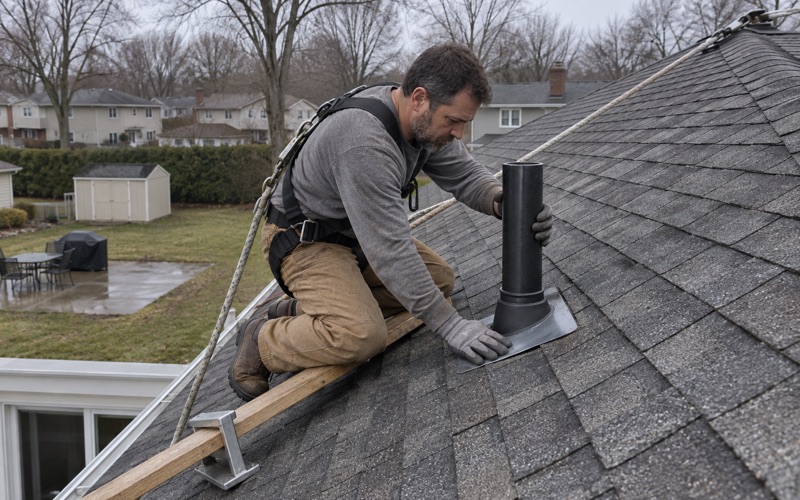
The 27 homes on bottled gas, along with many on utility gas, still have vent pipes for furnaces and water heaters coming up through the roof, plus the plumbing stacks every house has. Each one is sealed with a pipe boot, and the rubber collar on an older boot dries, splits and leaves a gap that leaks long before the shingles around it wear out.
We replace pipe boots as a matter of course on a full replacement rather than reusing them. On a repair visit, a cracked boot is often the whole answer, and a small fix like that is exactly the kind of straight repair we would rather hand you than talk you into a roof you do not need.
Looking for roofing closer to Collings Lakes? See Roofing Services in Collings Lakes.
Chimney and Flue Flashing at Re-Roof Time
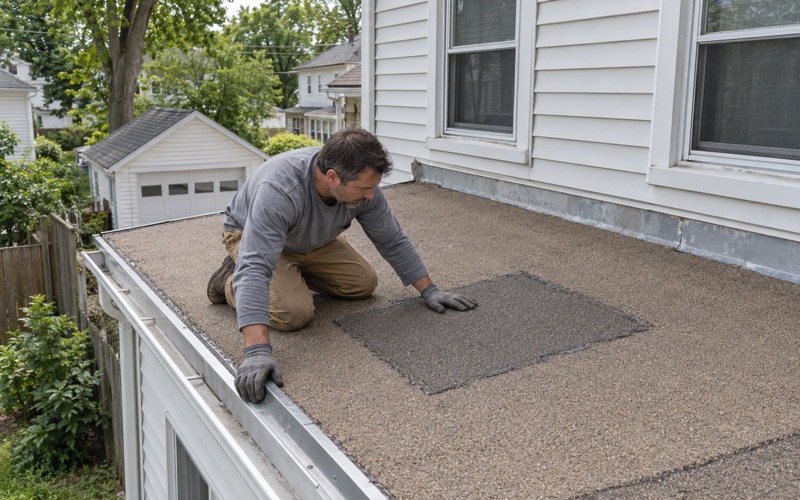
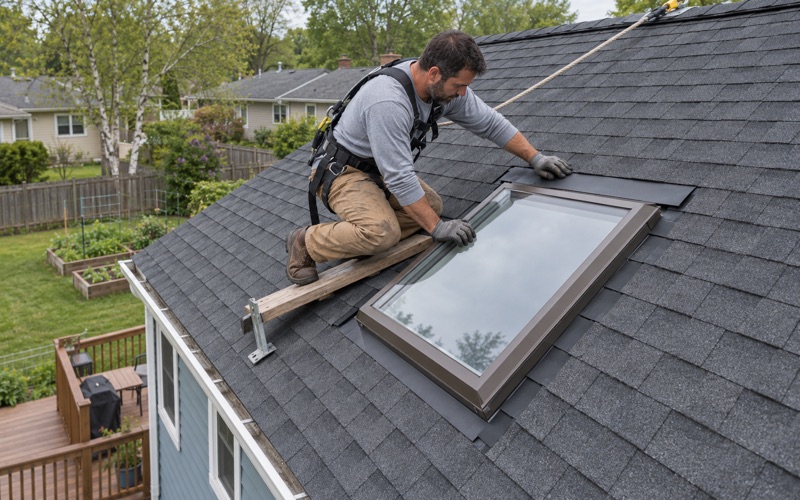
Flashing is where most chimney leaks start, and it is also where a rushed roof job is easiest to hide. A bead of caulk over tired metal looks fine on the day the crew leaves. When we redo a roof, the flashing at the chimney, at walls, at skylights and where two roof planes meet is replaced with new metal, not caulked over and left for the next storm to find.
Step Flashing and Counter Flashing
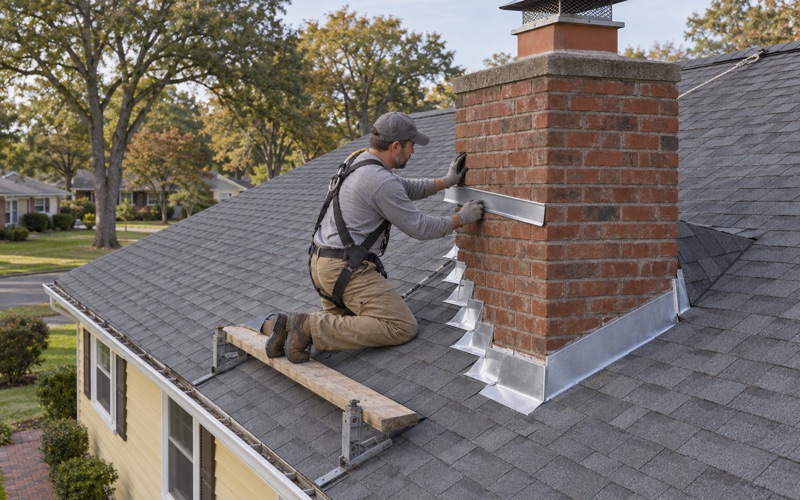
A properly flashed chimney uses two layers of metal working together. Step flashing is woven in with each course of shingles up the sides, and counter flashing is set into the masonry, ideally in a reglet cut into a mortar joint, so it laps down over the step pieces. Water running down the brick lands on the counter flashing and is carried over the shingles instead of behind them.
On many older houses we find counter flashing that was never let into the brick at all, just bent against it and smeared with roofing cement. That arrangement fails as the cement ages and cracks. Cutting a proper reglet and setting new counter flashing is part of how we price a chimney on a replacement, and it shows up as its own line on the scope.
Crickets Behind Wider Chimneys
Where a chimney sits below the ridge and faces upslope, water and leaves collect against its back side. A chimney cricket, sometimes called a saddle, is a small peaked frame built behind the chimney that splits that flow and sends it around both sides. Without one, the back of a wide chimney becomes a pocket of standing water every time it rains.
If your chimney is wide enough to need a cricket and the old roof never had one, we show you why and price it separately so you can decide. We also run self-adhering ice and water barrier rated to ASTM D1970 around the chimney base before the shingles go back on, which gives that joint a second line of defense under the metal.
Decking Around the Chimney
Years of small leaks at a chimney often leave the deck boards or plywood around it soft. Nobody knows exactly what is there until the old roof is off, so the contract sets a per-sheet decking price ahead of time. Any damaged sheet is photographed and shown to you before it is replaced, so there are no surprise charges and no guessing about what was under the shingles.
Laurel Lake’s 1960s to 1980s Houses and Rented Homes
Most of the housing in Laurel Lake went up in three decades. ACS counts show 311 units built in the 1960s, 269 in the 1970s and 307 in the 1980s, which is 887 of 1,253 units, or 70.8% of the stock. The median year built is 1977, and only 20 homes predate 1940, so the typical roof we see here sits on a house from that 1960s-to-1980s window.
Second Roofs on Original Decks
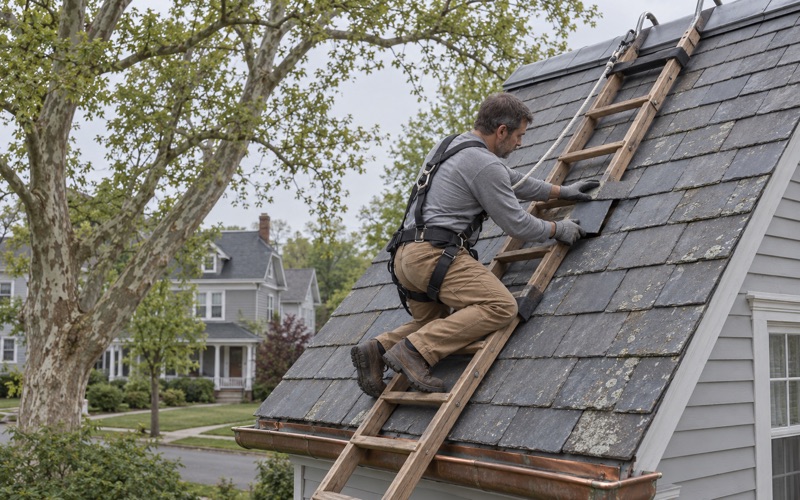
A house from those decades that still has its original deck has very likely been reroofed at least once already. That matters at the chimney more than anywhere else, because each earlier roofer had to decide how to handle the flashing. Some chose new metal and others chose a tube of sealant, and we find out which by opening up the old work rather than assuming.
Houses of this age have also usually been altered over the years, with added rooms, rerouted vents, or a stove installed long after the original build. Each change leaves its own penetration or roof-to-wall joint. We map them before work starts so each one lands in the scope with its own step, apron or kick-out flashing, instead of turning up halfway through the tear-off.
Ventilation on Older Attics
Many houses from the 1960s and 1970s were built with little attic ventilation, and a replacement is the cleanest time to fix that. We pair a ridge vent with soffit intake and balance the two by net free area, so warm, moist air from a house heated by oil or wood has a way out instead of condensing under the deck through the winter.
Rented Single-Family Houses
Of the 1,142 occupied homes in Laurel Lake, 311 are rented, or 27.2%, and 180 of those are detached houses. An owner of a rental needs a roof decision they can make from a distance, often with a tenant living under the leak. We send photos of the problem and of the attic, along with a scope written so you can approve it without standing in the yard.
For a rental with a working chimney or wood stove, we coordinate access with the tenant and schedule the flashing work for a day when the stove is cold. At the end of every work day the yard, driveway and gutters are cleaned and swept with a magnet for nails, which matters when a tenant’s children and cars are coming and going.
Woodland Edges, Lakeshore Drive and Local Paperwork
Laurel Lake sits about six miles south of Millville, outside the Pinelands National Reserve but close to its boundary, with nature preserves and forest lands almost completely surrounding it. For a roof, that setting mostly shows up as debris. Leaves and twigs that settle in gutters and behind chimneys hold moisture against the exact joints described above.
Debris, Gutters and the Back of the Chimney
On houses near the woods, including those along Lakeshore Drive by the water, we pay close attention to the gutters, the valleys and the upslope side of any chimney, where blown debris builds up first. Seamless aluminum gutters and leaders sized for the roof keep runoff moving, and a properly built cricket lets the back of the chimney shed leaves instead of collecting them.
Shingle choice is part of the same conversation. Architectural laminated shingles such as GAF Timberline HDZ, Owens Corning Duration or CertainTeed Landmark are common choices on houses like these, and we hold samples up against your brick or siding on site so the color is picked against the actual house rather than a brochure photo.
Commercial Township, Permits and Flood Maps
Laurel Lake is a census-designated place inside Commercial Township, so municipal matters run through the township and Cumberland County rather than a separate local government. N.J.A.C. 5:23-2.7 sets out which roof covering work on detached one- and two-family dwellings counts as ordinary maintenance, and we confirm with the township what a given job needs before we schedule it.
The township is NFIP community 340166A, with a current effective flood map dated 06/16/16. When a storm does damage here, we photograph and write it up for your own insurance claim and will meet the adjuster on site if you ask. National Weather Service forecasts for the community come from the Mount Holly office under zone NJZ021, the one to watch when a storm is on the way.
Scheduling Around the Heating Months
Because so many households here rely on oil or wood heat, we plan chimney work around it. Early fall, before the stove goes into steady use, is a good window, and a replacement can be sequenced so the flue opening is never left unsealed overnight. If a stove has to stay in use during the job, we tell you which days it needs to be out so the crew can work around the collar safely.
- 20+ Years in Roofing
- Attic-First Leak Checks
- Line-Item Written Scopes