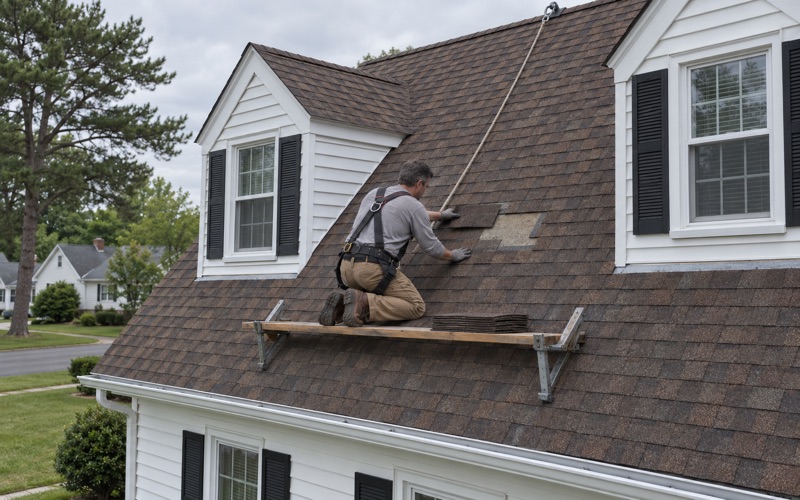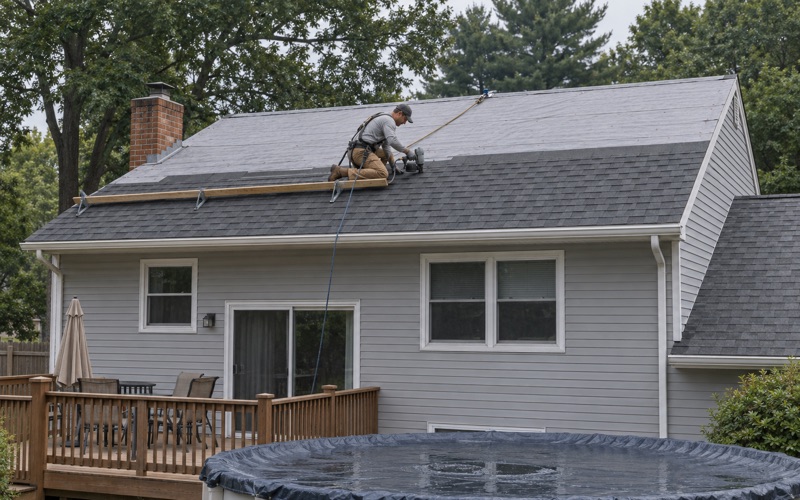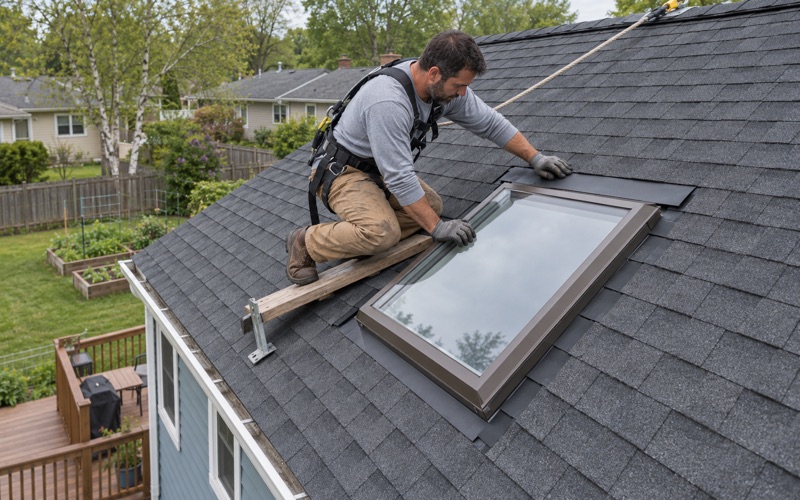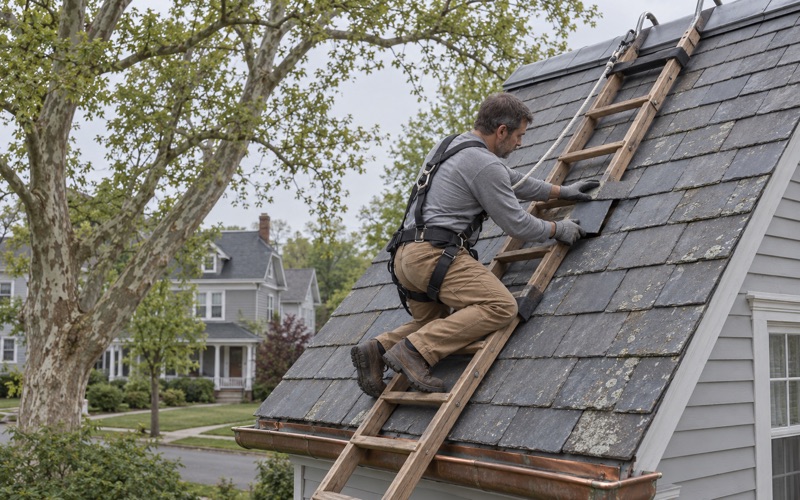
Vineland Elite Roofing brings more than 20 years in the trade to roofing in Harrison Township, and that includes the jobs where a solar array is sitting on the roof that needs work. Those projects turn less on the shingles than on sequence: who takes the panels off, when the tear-off starts, and how the array goes back on once the new roof is finished and inspected by our own crew.
We are roofers, not solar installers. We do not design arrays, disconnect systems or handle anything electrical, so the panel removal and reinstall is done by the solar company or electrician you choose. What we do is build that work into the roofing schedule from the first estimate, so nobody discovers on the morning of tear-off that the panels are still bolted to the deck.
The same habits apply to roofs with no panels at all. A leak call gets a look in the attic as well as on the roof, so the water is traced to where it actually enters. You hear whether a repair will do before replacement comes up, and every estimate breaks the job into lines you can hold up against another contractor’s price.
Harrison Township’s Rules for Solar on a Roof
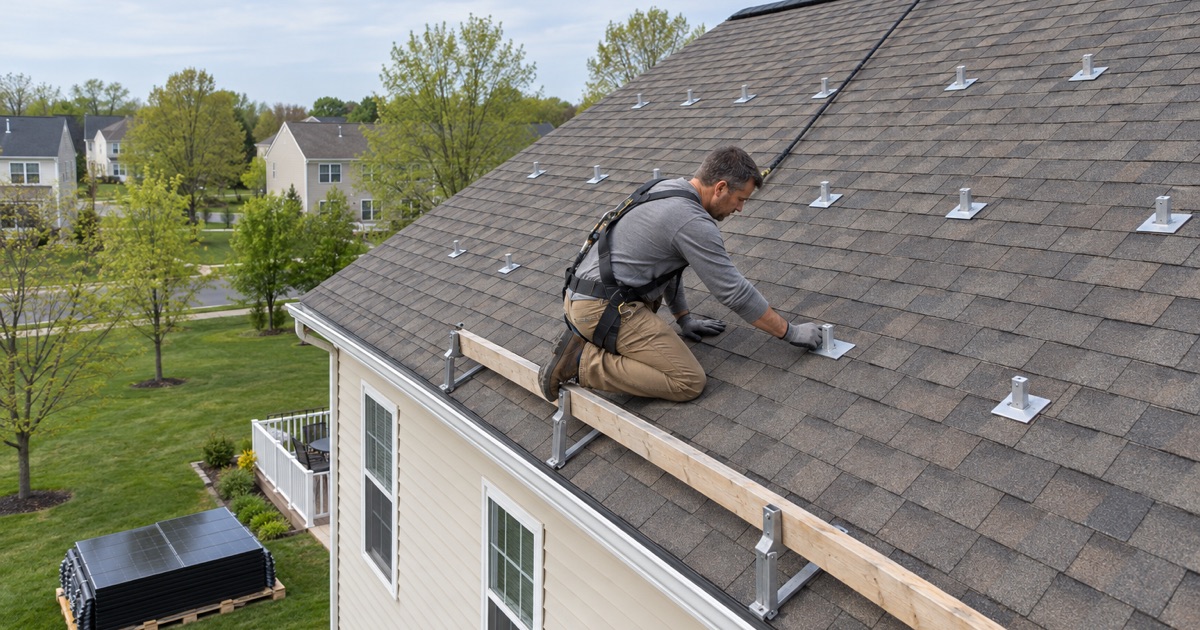
Harrison Township wrote its own rooftop solar rules into its zoning code at § 225-132D, added in 2011 by Ord. No. 14-2011 and amended through Ord. No. 4-2019. We read them before quoting any roof that carries panels, because they shape how the array has to sit on the finished roof. They are not suggestions, and the new roof has to leave room for the array to meet them again.
Permits Before Panels Go Up
The code says a rooftop installation requires a zoning permit from the Zoning Officer and a building permit from the township’s Construction Office before installation. It allows one system type per property, either rooftop or building-mounted collectors or a ground-mounted array, but not both. Rooftop collectors are permitted in every zone, and ground-mounted arrays must sit 50 feet back from property lines.
What the text we read does not settle is whether taking an existing array off and setting it back for a re-roof needs a new permit. We say that plainly rather than guess. Before the job is booked, we suggest you or your solar company confirm the answer with the township, so the start date does not hinge on an assumption either of us made.
Height, Edges and Black Frames
Panels may not rise above the highest point of the roof, and no part of the panels or the system may extend beyond the roof’s edge. Since Ord. No. 21-2017, every visible collector part, frames and support structures included, has to be black. Panels also may not go on a facade fronting a public right-of-way unless the Township Planner and a designated official certify the design.
Those limits carry into the roofing itself. The drip edge at the eaves and rakes marks the edge the array has to stay inside, so we keep that line where it was rather than extending or trimming it. Because the frames are black, we hold shingle samples up on site against both the siding and the panels before you pick a color, so the finished roof reads as one surface.
Size and Shape of the Array
A rooftop system in Harrison Township can be no larger than 1,200 square feet, a cap set by Ord. Nos. 4-2016 and 21-2017. The collectors have to be contiguously connected and arranged “to mimic the roof shape and design,” and their location and arrangement are subject to zoning approval. In other words, the array on your roof is a shape the township has already looked at.
That is why we treat the existing layout as the target for the reinstall rather than an open question. Before anything comes off, we photograph the array from the ground and from the roof, row by row, so the solar crew and our crew share one record of where every panel sat against the ridge, the rakes and the eaves.
Looking for roofing closer to Waterford? See Waterford Roofing.
Taking Panels Off and Putting Them Back
The remove and reinstall is the part of a Harrison Township re-roof that sets the calendar. The roof cannot be torn off with the array in place, and the array cannot go back until the new roof, flashing and penetrations are done. Our job is to make those two halves meet without days where the house sits open or the panels sit stacked in the yard longer than they need to.
Scheduling the Removal
Before we set a start date, we ask who installed your system and who will take it off. Once that crew has a removal date, our tear-off is booked for the work days right after it, and the reinstall date is set against our finish date instead of being left open. Your written scope shows the solar work as work by others, so it is clear what our price covers.
While the panels are down, the roof gets the full treatment rather than a patch around old mounts. We list tear-off, decking, underlayment, flashing, ventilation and gutters as separate lines, so two estimates can be compared item by item. If you are weighing our price against another roofer’s, that layout shows where the numbers actually differ.
What Turns Up Under an Array
Decking under panels has been out of sight for as long as the system has been up. If boards turn out soft or delaminated once the old roof is off, we photograph them and show you before replacing anything, at the per-sheet price already written into the contract. Nothing appears on the final bill that you did not see on the roof first.
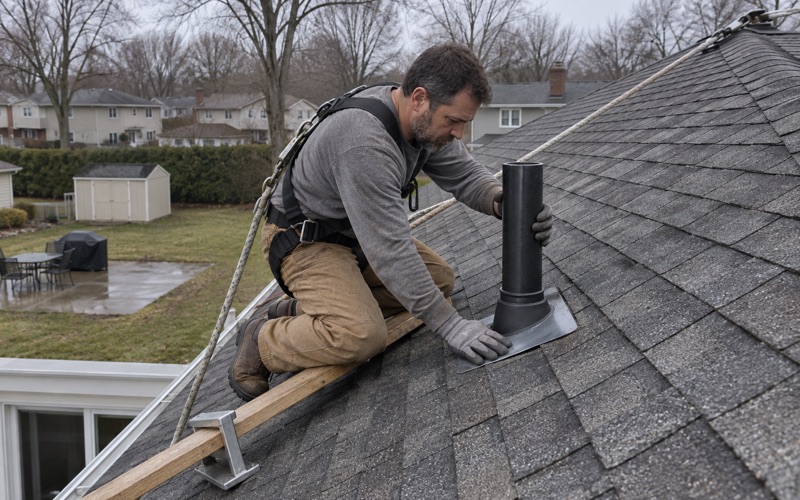
The penetrations get the same attention. Pipe boots, step flashing at sidewalls and flashing where two roof planes meet are replaced rather than caulked over, and we lay ASTM D1970 self-adhering ice and water barrier and ASTM D8257 synthetic underlayment where the roof calls for them. The ridge vent and soffit intake are checked too, since the slope under an array has been hard to see for years.
Back in the Approved Layout
When the solar crew returns, we plan around the array going back the way the township approved it: below the highest point of the roof, inside the roof edges, black frames, contiguous and following the roof’s shape. Our photos give everyone the same reference for where each row belongs. The electrical side and the system’s reconnection stay with your installer.
We stay in touch with that crew through the reinstall so a question about a mount or a flashing detail gets answered on the roof, not after everyone has left. If they need a section of the roof left open for their attachments, we plan that into our finish so the new shingles and flashing are not disturbed twice.
Solar in the Mullica Hill Historic District
Mullica Hill carries a second layer of rules. The Mullica Hill Historic District was created by Harrison Township Ordinance No. 14-1992 on August 31, 1992, and its National Register listing describes the core of the village of Mullica Hill. The district holds 149 eighteenth-, nineteenth- and early-twentieth-century buildings, and the township’s solar rules treat their roofs differently from the rest of the township.
Panels Out of Sight From the Street
Within the district, § 225-132D(7) says solar panels on roof surfaces shall not be visible from a public way. Solar shingles may go on a roof surface that is visible if low or nonreflective shingles are used. Finishes are to be nonreflective, and panels are to be similar in color to the roof materials around them.
For a roofer, that rule decides which slopes can carry visible panels at all. On a district property only the planes that cannot be seen from a public way qualify, so those are the slopes whose underlayment, flashing and venting we look at hardest before a reinstall. The street-facing slopes get roofing chosen for the house itself, matched on site against its brick, stone or siding.
Historic Roofing and the Original Roofline
The code also says an installation shall not be permitted if it results in removing historic roofing materials to add solar panels. Nor may it disturb the original roofline, dormers, chimneys or other original features. Those are the very parts of an old house a roofer handles most: the chimney flashing, the dormer cheeks, the valleys and the ridge.
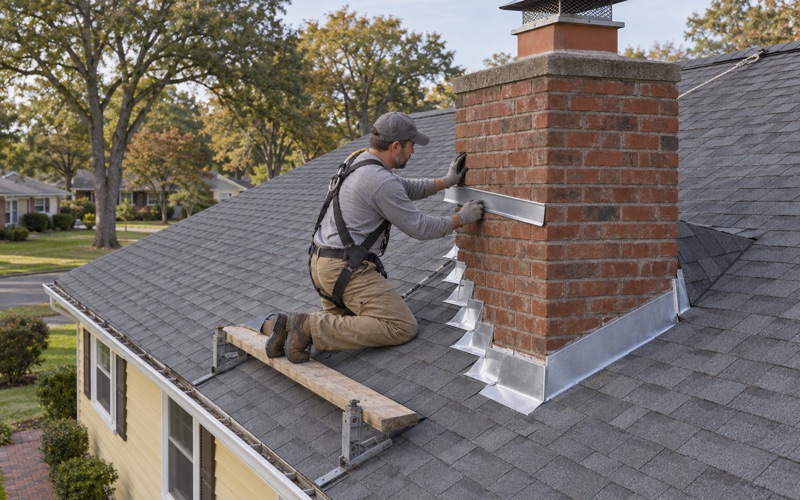
On a district roof we keep the roofline, dormers and chimneys as they are and set new flashing where the old flashing ran, rather than rerouting it. A chimney cricket or counter flashing set in a reglet goes back in the same position. On natural slate, slate hooks and individual repairs often serve the house better than a tear-off, and you hear that answer before any replacement is priced.
Harrison’s Newer Roofs Under Solar
Most of the township’s houses are not historic at all. Of 4,465 housing units in the ACS 2024 five-year estimates, 3,015, or 67.5%, were built in 1990 or later, and 3,917, or 87.7%, are detached. When one of those houses has panels, the array sits on a roof from the 1990s or 2000s, and any re-roof question arrives with the solar question attached.
Planning a Roof Before a New Array
If you are thinking about adding solar to an older roof, the order matters. Replacing a worn roof before an array goes on avoids paying for a remove and reinstall later on top of the roofing itself. We will tell you straight whether your current roof is sound enough to carry a system, or whether a repair is all it needs right now.
Where replacement does make sense, we price architectural shingles such as GAF Timberline HDZ, Owens Corning Duration or CertainTeed Landmark, with wind ratings to ASTM D3161 Class F or ASTM D7158 Class H shown on the scope. Choosing the shingle before the solar company draws its layout means the array is planned for the roof it will actually sit on.
Wind, Storms and Outbuildings
On September 1, 2021, an EF-3 tornado with an estimated peak wind of 150 mph crossed the township on a 12.6-mile path through Mullica Hill toward Deptford, according to the NWS Mount Holly survey. A year later the Harrison Township Fire Department chief said more than 100 homes were damaged and 39 were total losses. The same survey recorded most barns and storage buildings destroyed at a commercial farm on Bridgeton Pike.
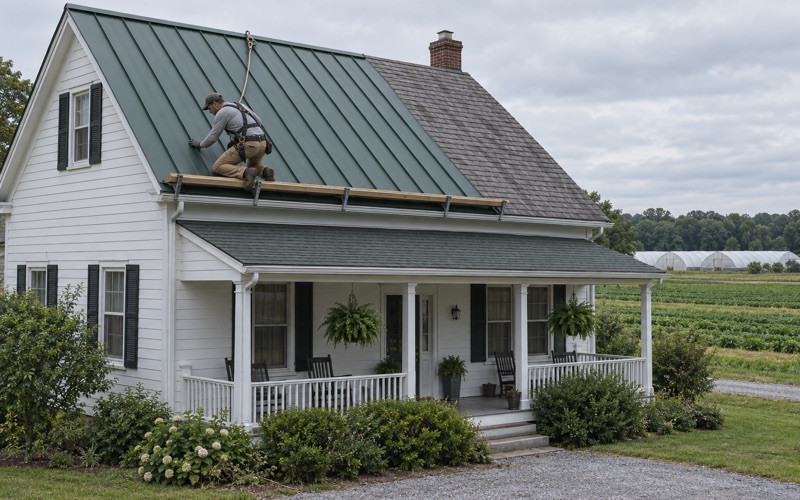
When wind damages a roof, panels or not, we photograph and write up the roof damage for your own claim, and our crew will meet the insurance adjuster on site if you ask. Barns, sheds and other farm outbuildings are quoted and scheduled around the working season, with exposed-fastener ribbed metal panels or standing seam metal where the building suits it.
Contracts and Daily Cleanup
Every contract follows New Jersey’s home improvement rules, including the written contract and the three-day cancellation notice. At the end of each work day the yard, driveway and gutters are cleaned and the ground gets a magnet sweep for roofing nails. That matters on any job, and more so when a solar crew and its ladders are due back on the same property.
- 20+ Years in Roofing
- Attic-First Leak Checks
- Line-Item Written Scopes