
Vineland Elite Roofing handles commercial roofing in Vineland, NJ, serving surrounding cities including Buena, Millville, Buena Vista, Rosenhayn and Pittsgrove. For more than 20 years we have repaired and replaced roofs on storefronts, offices, warehouses, churches and apartment buildings, most of them flat or low-slope. Those roofs depend on a continuous membrane, sound drains and careful edges, and they fail in different ways from a shingled house.
Vineland’s housing alone shows how much of this work there is. Three in ten occupied homes in the city are rented, and 1,172 renter households live in buildings of 50 or more units, according to the Census Bureau’s 2024 five-year survey. Add the commercial buildings along the main corridors, and low-slope roofing is a large part of what keeps local property in service.
Commercial re-roofs in New Jersey fall outside the ordinary-maintenance rule that lets one- and two-family homes be re-roofed without a permit, so they are permit work. We plan the permit, the schedule and the protection of tenants and customers before the job starts, and price every part of it in writing.
Membrane Roofing Systems
EPDM Rubber
EPDM is a black synthetic rubber membrane that has been used on low-slope roofs for decades. It is installed in large sheets with seams joined by adhesive or seam tape, and it stays flexible in cold weather. EPDM is a common choice for roofs with few penetrations and modest foot traffic.
The seams are its weak point. Over time, poorly made or aging seams can open, and the membrane can shrink and pull away from walls and curbs. We inspect and repair seams with compatible primers and tapes, and on replacements we pay close attention to how each seam and flashing is made.
TPO and PVC Single-Ply
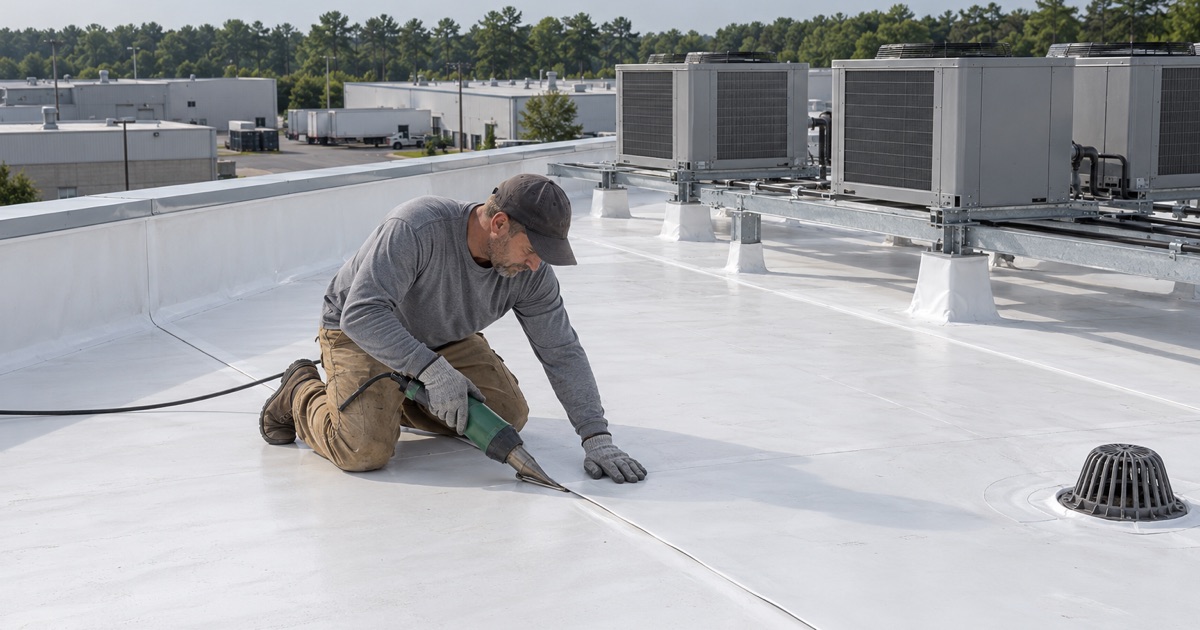
TPO and PVC are single-ply membranes, usually white, with seams that are welded together with hot air. Welded seams form a continuous sheet rather than a glued joint. The white surface reflects sunlight, which can reduce heat gain in the building below.
These membranes suit roofs with rooftop units, larger areas and owners interested in a reflective surface. Repairs need to use the same type of membrane, since TPO and PVC cannot simply be patched with other materials. We identify the existing membrane before any repair is quoted.
Modified Bitumen
Torch-down SBS and APP modified bitumen is installed in layers, with a granulated or coated cap sheet on top. Multiple layers give it a thick, tough surface that handles foot traffic well, which is why it is often found on roofs with frequent maintenance visits. It is also common on smaller commercial and mixed-use buildings.
Repairs and new installations require care at the edges, laps and flashings, where the layers are sealed together. We use compatible products for patches and tie-ins, and we follow safe torch practices on every job, especially near walls, curbs and wood framing.
Repair, Recover or Replace
Commercial Roof Repairs
Most commercial leaks start at seams, flashings around rooftop units, drains, edge metal or punctures from foot traffic. Because water moves sideways on a flat roof, the interior leak may be well away from the damage. We trace it by working outward from the interior location and checking the likely entry points.
Repairs are made with materials compatible with the existing roof and documented with photos. Property managers receive a short written summary of what was found and fixed, which helps when the same area needs attention again.
Recover or Full Tear-Off
When a roof has reached the end of its life, there are two main options. A recover installs a new membrane over the existing roof, which can save tear-off costs if the existing insulation is dry and the roof has not already been recovered. A full tear-off removes everything to the deck, allowing wet insulation and damaged deck to be replaced.
We check the existing roof, including the condition of the insulation, before recommending either. The written scope lists tear-off, insulation, membrane, flashing, edge metal and drains as separate lines so you can compare quotes on the same basis.
Planning Commercial Roofing Work
Permits, Schedules and Tenants
Commercial roofing in New Jersey is permit work, and we build the permit into the timeline from the first estimate. We agree on staging areas, material deliveries and work hours with the owner or manager, and plan around business hours or tenant routines where possible. Entrances and walkways are protected during the job.
On apartment buildings, residents are notified ahead of the work and kept informed of the schedule. Crews follow fall protection requirements throughout, and the site is cleaned at the end of every working day, including a magnet sweep for nails around entrances and parking areas.
Drains, Edges and Rooftop Equipment
Good drainage is what keeps a flat roof working. On every job we check drains, scuppers and gutters, and correct areas where water ponds for long periods. Edge metal is secured so wind cannot get under the membrane at the perimeter.
Rooftop units, exhaust fans and skylights sit on curbs that need proper flashing. We flash each curb with membrane run up its sides and under the cap, and coordinate with your mechanical contractor when equipment needs to be lifted or disconnected during a replacement.
Inspections and Maintenance for Commercial Roofs
Spring and Fall Roof Checks
A flat roof rarely announces a problem until water is already inside, so regular checks are the cheapest protection a building owner has. In spring we look for winter damage to seams, flashing and edge metal; in fall we clear drains and scuppers before leaves and storms arrive. Each visit covers the membrane, curbs, penetrations and parapet copings.
Small problems found on these visits, such as an opening seam or a loose piece of edge metal, are usually quick to fix. Left until the next leak, the same problem can soak insulation across a wide area, turning a minor repair into a section of tear-off. The cost difference between the two is what makes routine inspections worthwhile.
Written Reports for Owners and Managers
After every inspection, the owner or manager receives a written report with photos and the location of each item on the roof. Urgent repairs are separated from items that can wait for a later season, so the work can be budgeted rather than handled as emergencies. The report is detailed enough to put out to bid if you want comparison quotes.
Over several years, those reports build a history of the roof. When it is time to plan a recover or replacement, that history shows which areas have caused repeated trouble and helps set a realistic timeline, instead of a decision forced by the next major leak.
- 20+ Years in Roofing
- Attic-First Leak Checks
- Line-Item Written Scopes