Vineland Elite Roofing brings more than 20 years in the trade to roofing in Bellmawr, where the next re-roof on a house is seldom the first one it has had. On an older home the worn shingles you can see from the street are only the top of the story. What matters for the price and the schedule is what sits underneath them, and how much of the original roof is still sound.
When a homeowner calls about a leak, we look in the attic as well as on the roof, because water that shows up on a bedroom ceiling often enters somewhere else entirely. Tracing it to the actual entry point comes first. Then you get a plain answer on whether the roof can be repaired, and replacement only comes up if a repair would be money spent on a covering that is already finished.
If replacement is the right call, our written scope breaks the job into separate lines for tear-off, decking, underlayment, flashing, ventilation and gutters. That format lets you set our estimate beside anyone else’s and compare item by item instead of guessing what a single lump-sum number includes. The contract follows New Jersey’s home improvement rules, with the written agreement and the three-day cancellation notice.
Bellmawr’s Building Boom and the Roofs Since
A borough that filled in within two decades
Bellmawr was incorporated in 1926 from part of Centre Township and named for farm owner Ernest C. Bell. For its first years it stayed small: the census counted 1,250 residents in 1940. By 1950 the figure was 5,213, and by 1960 it had reached 11,853, more than doubling in ten years.
That kind of growth leaves a mark on the housing. A borough of 3.11 square miles does not add thousands of people without building street after street of new homes in a short window. The roofs on those homes were all installed around the same time, and they have been aging on roughly the same clock ever since.
What the housing count shows
The Census Bureau’s 2024 five-year estimates count 5,016 housing units in Bellmawr. Of those, 1,431 were built in the 1950s and 1,502 in the 1960s, so 2,933 homes, or 58.5 percent, date from those two decades alone. Another 768 went up in the 1940s.
One neighborhood profile describes the housing from the ’40s through the ’60s as predominantly capes and ranches, modest in size. Those are straightforward roof shapes, a steep cape gable or a low, wide ranch hip, but simple framing does not mean a simple re-roof once the history of the covering is factored in.
Why a 1950s roof is rarely on its first covering
A roof on a house built in the 1950s or 1960s has now been in service for more than sixty years. Over that span the roof has almost certainly been re-covered at least once. On many houses of that age, the cheaper route at the time was to nail new shingles straight over the old ones rather than strip them.
Nobody keeps a record of how many layers are on a given Bellmawr house, and we do not assume a number before we see it. What the age tells us is that the next re-roof on one of these homes is usually a full tear-off, and that the tear-off is where the real condition of the roof comes to light.
Looking for roofing closer to Pennsville? See Roofing in Pennsville.
Tear-Off and the Layers Underneath
Why we strip the roof instead of covering it again
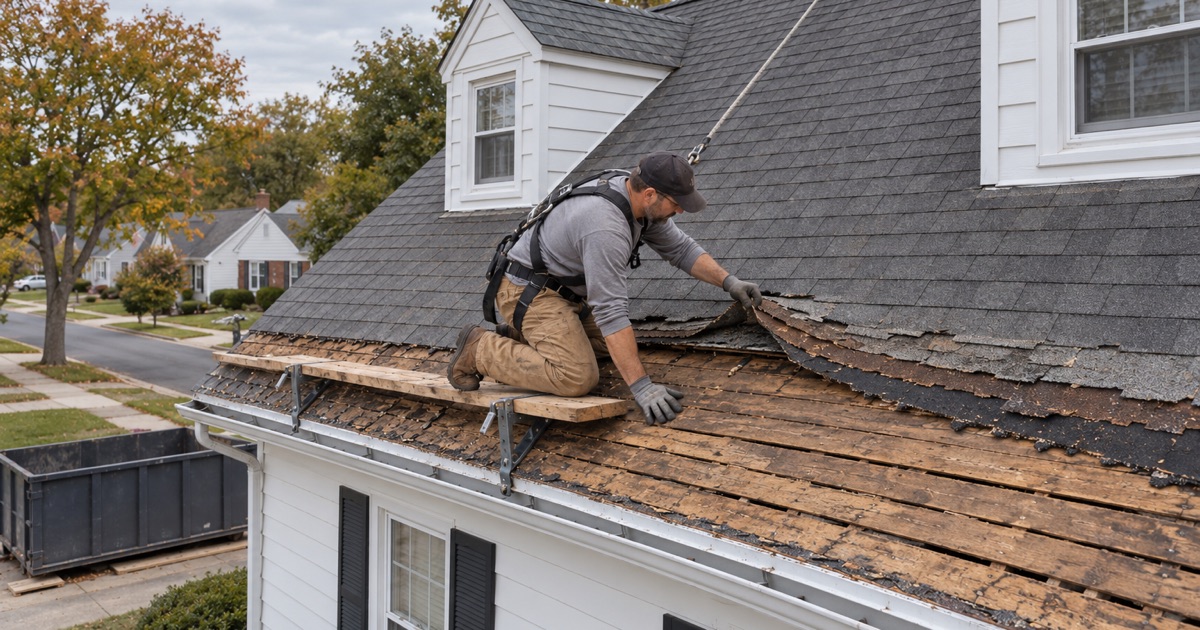
Another layer over an existing one hides whatever is wrong below it: soft decking, rotted edges, rusted flashing and old nail holes that never sealed. It also stacks more weight on the same framing every time it is done. A tear-off removes everything down to the deck so the new roof starts on a surface we have actually seen and can vouch for.
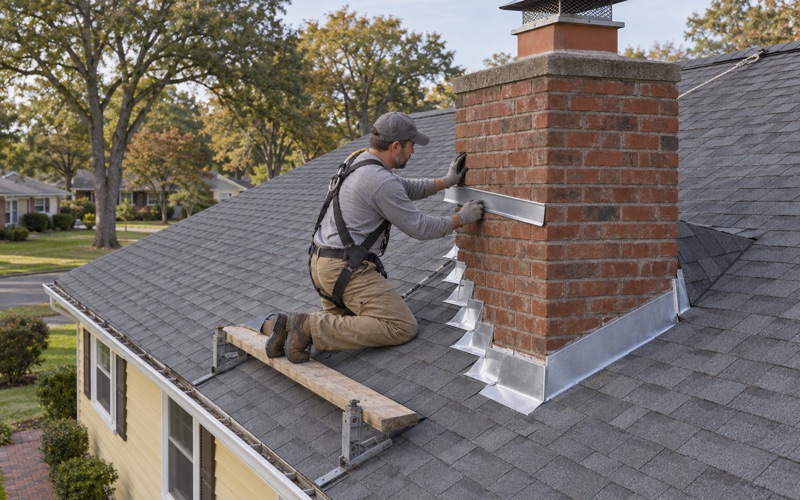
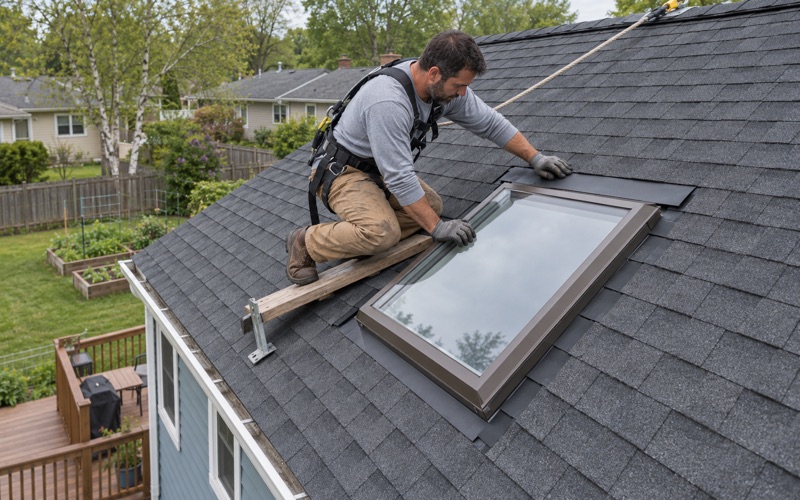
Stripping the roof is also the only way to replace flashing properly. At chimneys, walls, skylights and anywhere two roof planes meet, we put in new metal rather than caulking over the old pieces. On a house that has been re-covered before, that flashing has often been lapped and sealed several times already.
Reading the edges before the bid
Before we price a tear-off, we check the eaves and rakes, where a cross-section of the roof is sometimes visible at the drip edge or under a lifted tab. That gives us a working estimate of how many layers to expect and how much debris the job will produce. We note it in the scope so the number is not a surprise.
The edge does not always tell the whole truth, since an earlier crew may have cut back old layers at the perimeter. If the tear-off turns up more than the estimate assumed, we show you before the work continues. The scope is written so that an extra layer is a known line, not an open-ended charge.
Scheduling the day the roof comes off
A tear-off leaves the deck open, so the weather on that day matters more than on any other part of the job. Bellmawr falls under the National Weather Service’s Mount Holly office in the Camden forecast zone, NJZ018, and we plan the strip-off around that forecast. Each section we open is dried in with underlayment before the crew leaves.
Older layers mean more debris, and more debris means more cleanup. At the end of every work day we clear the yard, the driveway and the gutters, and run a magnet sweep across the lawn and walks for loose roofing nails. A family on a narrow residential lot should be able to park and walk out the door that evening.
The Original Roof Deck on a Postwar Cape or Ranch
What sixty years does to a deck
The deck is the layer the shingles are nailed into, and on a postwar house it may be the original one. Each covering that went on over the years drove another round of nails through it. Spots that sat under a slow leak, around a chimney or along a cold eave, can be soft or delaminated even when the shingles above them looked fine.
What the original deck is made of, and what shape it is in, is not written down anywhere for a Bellmawr home. We do not guess from the street. Once the old layers are off, the deck is in plain view, and we walk it and mark every section that will not hold new fasteners.
Damaged decking shown to you first
Any decking we find that needs replacing is photographed before anything is cut out, and those photos go to you. You see the same rot, cracks or soft spots we do, and the decision is made on evidence rather than on our word alone.
Replacement decking is billed at a per-sheet price written into the contract before the job starts. That way a bad deck changes the total by a figure you already agreed to, and the price of the job does not move on the day of the tear-off depending on what the crew happens to find.
Building the roof back up
With the deck sound, we install drip edge at the eaves and rakes, a self-adhering ice and water barrier meeting ASTM D1970 along the eaves and in valleys, and synthetic underlayment over the field. Ventilation is planned as a system, with a ridge vent balanced against soffit intake, so the attic can breathe from the eaves to the peak.
For the field we usually suggest architectural shingles, such as GAF Timberline HDZ, Owens Corning Duration or CertainTeed Landmark. We hold samples up against the brick, siding or stone on your actual house so the color is picked in daylight, not from a small chip in a brochure. If solar panels sit on the roof, their removal and reinstall go into the schedule from the start.
Attached Homes, Rentals and Storm Work
Roofs that share a wall
Not every older Bellmawr home stands alone. The census counts 859 one-unit attached houses, about 17.1 percent of the housing, and 620 of those are rented while 214 are lived in by their owners. A roof on an attached house meets the neighbor’s roof at the party wall, and that joint needs more care than any other part of the job.
When we re-roof one unit in an attached row, we treat the line where the two roofs meet as its own piece of work. The new flashing and underlayment have to tie into whatever is next door without tearing up a roof we were not hired to touch. We talk through that transition with the owner before the crew arrives.
Timing a re-roof around tenants
Bellmawr requires a Rental Certificate of Occupancy for residential rentals, with an inspection each year and another for every new tenant, scheduled by the landlord. The borough’s rental page does not list roof items, so we would never tell an owner a new roof is needed to get through it. What landlords often prefer is doing a tear-off between tenants, when nobody has to live under an open deck.
For owners with several properties, a straight repair-or-replace answer on each roof helps plan spending over a few years instead of all at once. We put each roof’s findings in writing, with the same line-by-line scope, so a landlord can rank which building needs attention first.
After a storm
When wind or hail damages a roof, we photograph what we find and write it up so you have documentation for your own claim. If you want us there, our crew will meet the insurance adjuster on site and walk the roof with them. The claim stays yours to file and manage.
Storm damage on an older roof is also a moment to check what is underneath. A missing tab on a house with several layers may expose old shingles rather than underlayment, and we will tell you plainly if a patch makes sense or if the roof is past the point where a repair would hold.
- 20+ Years in Roofing
- Attic-First Leak Checks
- Line-Item Written Scopes